Home
/
Blog
/
AI Recruiting
/
5 must-have proctoring tips for a developer assessment platform

5 must-have proctoring tips for a developer assessment platform

Author
Pritika
Calendar Icon
June 14, 2019
Timer Icon
3 min read
Share

Explore this post with:

Amidst a plethora of solutions crowding the developer assessment space, how do you choose the best one? It boils down to one crucial factor: The quality of the screening process itself. Proctoring or anti-cheating mechanisms cement the foundation of an excellent screening process. A proctored assessment ensures that candidates taking a test do not cheat. And why is that so critical? It affects the output of deserving candidates who are fit to be shortlisted.

The gaping hole in your screening process

According to a study by The Center for Academic Integrity, almost 80% of college students admit to cheating at least once during their educational career.

Unlike an offline test, an online test allows candidates to take a test remotely from a different location. On top of that, if you have no one supervising the candidates, you’ve just declared an open season for cheating!

What’s worse– You end up with a skewed pool of candidates who are not qualified enough to be shortlisted, but who still end up making the cut.

The fix: Proctoring and anti-cheating mechanisms

HackerEarth’s coding assessment platform is backed by powerful proctoring settings that make your tests completely cheat-proof. Here’s how you can increase the quality of your screening process using these tips:

Stop plagiarism– No more ‘copy and paste’

Encourage candidates to come up with answers based on their own logical and programming skills. Leave no room for them to rely on unethical shortcuts to find a solution to their problem.

HackerEarth assessments have a feature to disable candidates from copying code from the Web or another local computer and pasting it on the code editor. In addition, the platform also disallows candidates from copying problem statements from the question library and sharing it on the web.

Pro feature: The platform has the ability to compare code written by two candidates and check if the lines have been plagiarised. We also have a strict anti-plagiarism policy. You can read it here.

Comparing lines of code written by candidates on the HackerEarth platform

Say no to impostors– Take candidate snapshots

When you are assessing candidates remotely, you need to be sure that the right person is taking the test. Prevent impostors from taking advantage of an online assessment by ensuring you have a visual proctor in place.

Using a webcam, the HackerEarth platform takes regular snapshots of the candidate during a test. A thumbnail preview of the webcam is displayed on the bottom right of the screen to indicate that candidates are being monitored. It can also be used to monitor the candidate and their movements during a test.

Keep a ‘tab’ on your candidate– Disable tab switching

Establish a controlled test environment for candidates to remain focused on the test and answer honestly. Do away with a candidate’s temptation to switch to another window or tab to browse answers. HackerEarth’s platform issues a warning each time a candidate tries to leave the test environment. This is measured by the number of tab switches made by the candidate. And if a candidate makes more than 5 tab switches, they are automatically logged out of the test environment.

Setting to enable tab switching during a test

Remove distractions– Enable full screen mode

Provide an environment devoid of distractions. Using the HackerEarth platform, you can enable the full screen mode for candidates taking a test. The platform issues a warning to candidates if they exit the full screen mode.
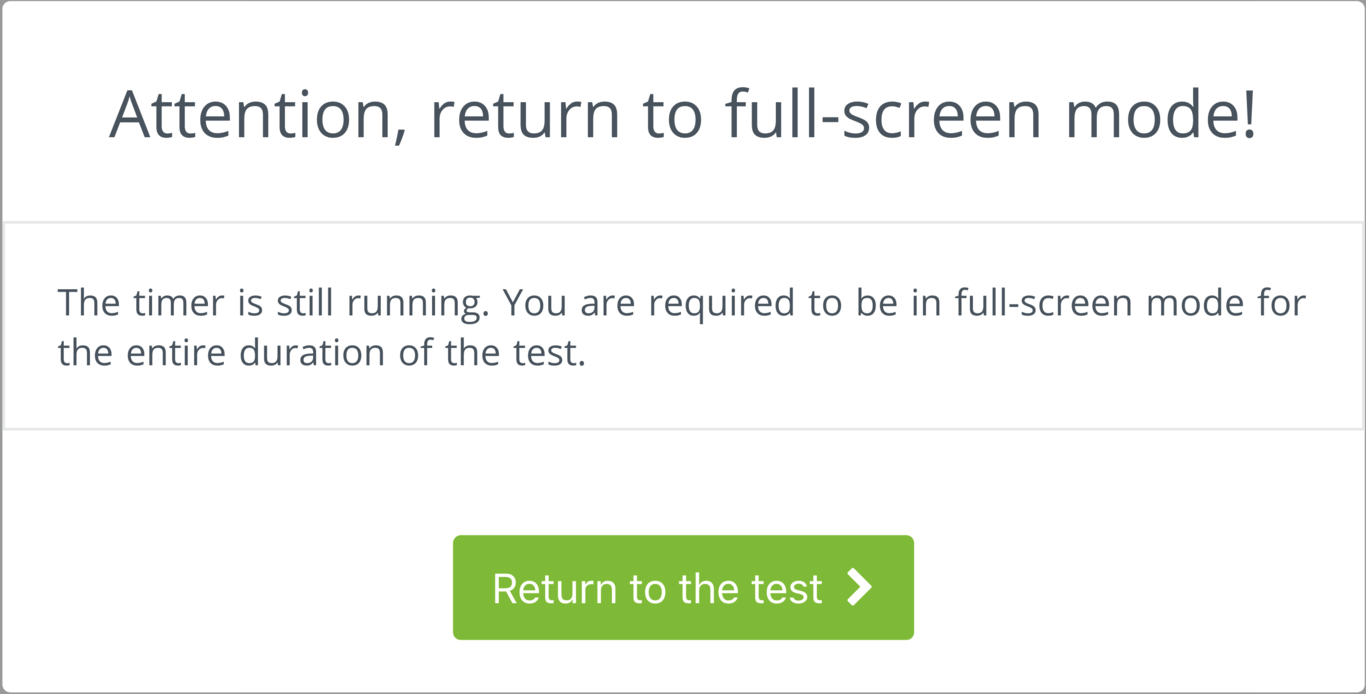
Enable full screen mode during a test

Know where your candidate is– Restrict IP addresses

Sometimes it’s better to know if the candidates are taking the test from the right location, especially if there’s a recruitment drive or if you’ve invited a candidate to take the test from a specified place. HackerEarth also has a feature to restrict IP addresses to contain the test-takers in a single location. With this feature, a warning is displayed if the candidate tries to login from an IP that is outside the restricted range.

The need for effective proctoring mechanism for tech assessments

In the evolving landscape of talent acquisition, particularly in technical fields, proctoring mechanisms have become crucial. They are not just tools for ensuring integrity during assessments but also play a significant role in shaping the overall quality and reliability of the hiring process.

  • Ensuring assessment integrity: In an era where remote assessments are common, proctoring mechanisms help maintain the integrity of the evaluation process. They prevent dishonest practices like cheating or impersonation, ensuring that the skills and knowledge assessed are genuinely those of the candidate. This integrity is vital for businesses aiming to hire the best talent based on merit.
  • Quality of hire: Proctoring mechanisms contribute to the quality of hire. By ensuring that only candidates who have legitimately cleared the assessments are considered, businesses can be confident in their hiring decisions. This is especially important in technical fields where specific skills and competencies are critical for job performance.
  • Brand reputation: Fair and transparent assessment processes, backed by robust proctoring, enhance a company’s reputation among potential candidates. In a competitive job market, a reputation for ethical and rigorous evaluation processes can attract high-caliber applicants.
  • Legal and compliance aspects: In certain industries and regions, there are legal and regulatory requirements regarding the hiring process. Proctoring mechanisms help in complying with these standards, avoiding potential legal issues related to biased or unfair hiring practices.
  • Data-driven insights: Modern proctoring tools often come with analytics capabilities. These tools provide valuable insights into candidates’ behavior during assessments, helping businesses refine their hiring process and criteria.
  • Global talent reach: Proctoring mechanisms allow businesses to conduct assessments globally without compromising on quality or integrity. This expands the talent pool, enabling companies to access the best talent irrespective of geographical boundaries.

The HackerEarth Smart Browser is an AI-powered online exam proctoring application designed to prevent cheating through the use of LMS like ChatGPT in online tests. It offers robust invigilation capabilities by restricting actions like screen sharing, running parallel applications, resizing the test window, copy-pasting code, using malicious keystrokes, accessing OS notifications, using a virtual machine, and accessing browser developer tools. The browser creates a sealed-off testing environment and employs eagle-eyed monitoring, including recording the test window and taking snapshots via webcam. It ensures reliable assessments suitable for any organization size, adhering to industry-leading compliance, security, and scalability standards.

So, there you have it. A few useful tips to ensure that your assessment platform is cheat-proof.

If you want to know more about how you can conduct quality developer assessments using these tips, sign up for our 14-day free trial.

Have a great day!

Popular posts like this:

  1. HR guide to hiring people with disabilities
  2. 8 ways to hire a developer [Actionable tips]
  3. 5 reasons you should use tech recruitment software

Subscribe to the HackerEarth blog and enrich your monthly reading with our free e-newsletter – Fresh, insightful and awesome articles straight into your inbox from around the tech recruiting world!

Subscribe to The HackerEarth Blog

Get expert tips, hacks, and how-tos from the world of tech recruiting to stay on top of your hiring!

Author
Pritika
Calendar Icon
June 14, 2019
Timer Icon
3 min read
Share

Hire top tech talent with our recruitment platform

Access Free Demo
Related reads

Discover more articles

Gain insights to optimize your developer recruitment process.

Skills-based Hiring: A Shift From Credentials To Competencies

The global talent crisis and the economic cost of unfilled roles

There is a growing gap between the skills employers need and what job seekers offer, putting both economies and companies at risk. As technology evolves quickly, relying solely on education and work history is not enough. Employers struggle to find qualified people, and many job seekers cannot find roles that recognize their true skills.

Research from Korn Ferry shows that by 2030, there could be a shortage of over 85 million workers worldwide. If this continues, the global economy could lose about $8.5 trillion each year. The problem is especially serious in fields like cybersecurity, which already needs 4 million more professionals, and the semiconductor industry, which will need another million skilled workers by the end of the decade.

Several factors are causing this talent shortage. As Baby Boomers retire, the workforce loses years of experience, and the rapid growth of artificial intelligence is changing the skills needed for many jobs. LinkedIn data shows that the skills required for a typical job have changed by about 25% since 2015, and this pace is expected to double by 2027. In this situation, a degree is no longer a reliable sign of current skills. Organizations need to shift to a more flexible, skills-based hiring approach.

Defining skills-based hiring and the transition from traditional proxies

Skills-based hiring, also called "skills-first" hiring, means selecting candidates based on their specific hard and soft skills rather than their education or past job titles. Traditionally, employers used a four-year degree as a shortcut to judge ability and knowledge. But now, people can gain valuable skills through boot camps, community colleges, military service, or work experience, making the old approach less reliable.

The old way of hiring assumes that having a degree or a job at a well-known company means someone will perform well. This "pedigree bias" has led many jobs, such as administrative support or entry-level IT roles, to require degrees even when they are not needed. A skills-based approach breaks down each job into the exact skills needed. It asks, "What does this person need to do from day one?" and "How can we measure that skill fairly?"

This shift requires a fundamental re-engineering of the recruitment funnel. Instead of a resume acting as the primary gatekeeper, objective assessments and technical evaluations take center stage. Platforms like HackerEarth allow candidates to demonstrate their proficiency in real-world coding environments, regardless of whether they have a computer science degree.

Switching to this model is not just a trend; it is needed. Research shows that hiring for skills predicts job success five times better than hiring for education and 2.5 times better than hiring for work experience alone. By focusing on skills rather than degrees, companies can find better candidates and reduce biases that have excluded many skilled workers.

The rhetoric versus reality gap in 2025 and 2026

A key issue with skills-based hiring is the gap between what companies say and what they do. By 2025, 85% of employers say they use skills-based hiring, a much higher rate than before. But a 2024 study by Harvard Business School and The Burning Glass Institute found that dropping degree requirements has had little real effect. Less than 1 in 700 hires (0.14%) changed because of these new rules. This shows that even when HR updates job postings, hiring managers still mostly pick candidates with traditional credentials, especially in final interviews. This often happens because managers are unsure about new ways to measure skills or prefer what they already know.

This shows that real change is harder than just removing a checkbox on a job application. True skills-based hiring means using clear ways to assess skills, such as the HackerEarth assessment library and the FaceCode interview tool. These give hiring managers the data they need to trust candidates with non-traditional backgrounds. Without these tools, skills-based hiring could become just another buzzword instead of a real strategy.

Expanding the talent pool: reaching the STARs

The main benefit of skills-based hiring is that it quickly expands the pool of people companies can hire. Dropping the bachelor’s degree requirement gives access to about 70 million U.S. workers who are "Skilled Through Alternative Routes" (STARs). These workers are already active in many fields, from retail to healthcare, and have valuable skills from military service, certificate programs, or years of work experience.

Economic efficiencies: time and cost savings

In today’s competitive economy, hiring faster and smarter gives companies an edge. Traditional hiring takes a long time because recruiters have to review hundreds of resumes, many of which are made by AI tools. Skills-based hiring uses automation and AI to speed up the hiring process and reduce time-to-hire.

Reports show that 91% of companies using skills-based hiring have made their hiring process faster. Almost 20% have cut their hiring time in half. For non-senior roles, companies can save 339-660 hours of recruiter and manager time per hire with a skills-first approach.

The cost savings are also strong. Replacing an employee usually costs about 33% of their yearly salary. By hiring better from the start and using fewer expensive headhunters, companies can save between $7,800 and $22,500 for each role. In total, 74% of employers say skills-based hiring has lowered their recruitment costs.

These time and cost savings are even bigger with tools like HackerEarth. Its automated grading and leaderboards let recruiters review thousands of candidates at once and quickly find the best people, using data rather than reading every resume. This makes it easier to fill many jobs and keeps hiring fast and affordable.

The retention advantage: building long-term workforce stability

Retention is now the main challenge for 66% of HR leaders. High turnover, especially among younger workers like Gen Z, disrupts operations and causes knowledge loss. Skills-based hiring is proving to be one of the best ways to retain employees.

LinkedIn and McKinsey data show that employees without four-year degrees stay in their jobs 34% longer than those with degrees. In companies that use skills-based hiring, 89% report a significant increase in employee retention.

This loyalty is built on trust. When companies value skills and offer "career-changing opportunities" to people without traditional backgrounds, those employees are more likely to stay and stay engaged. Skills-based hiring also shows employees what skills they need to advance, turning retention problems into growth opportunities. Companies that use these methods are 98% more likely to retain their best workers.

Fostering diversity, equity, and inclusion (DEI)

Using college degrees as the main hiring filter has acted as a "paper ceiling," keeping out many people from marginalized backgrounds who did not have access to top schools. For example, 62% of Black workers, 54% of Hispanic workers, and 70% of Native American workers in the U.S. are STARs—Skilled Through Alternative Routes.

Skills-based hiring is a powerful way to support diversity, equity, and inclusion. Deloitte research shows that 80% of business leaders think it reduces bias and makes hiring fairer. By looking at real skills instead of where someone went to school or who they know, companies give more people a fair chance.

A four-step implementation guide for skills-first hiring

Moving from traditional hiring to a skills-first approach is a major change and means companies need to update their recruiting methods. The four steps below give a guide for organizations that want to modernize how they find talent.

Step 1: Identify and deconstruct role-specific skills

The first step is to go beyond general job descriptions and list the exact, proven skills needed for a role. This means working with hiring managers to separate "must-have" skills needed right away from "preferred" skills that can be learned later. Companies should consider both technical and soft skills, such as communication and teamwork.

Step 2: Redefine job postings to focus on capabilities

After identifying the required skills, companies should rewrite job descriptions to focus on skills rather than credentials. Research shows that skills-based job postings attract more applicants and get 42% more responses. Companies should clearly say that a college degree is not required and that they will consider other work, life, or educational experiences.

Step 3: Implement objective, data-driven assessments

To ensure candidates have the right skills, companies should use practical tests rather than just reviewing resumes. Technical platforms like HackerEarth are key for this. With a library of over 40,000 questions, companies can build coding tests that mimic real job tasks. For interviews, tools like FaceCode let candidates pair-program in real time, demonstrating their logic and problem-solving skills more effectively than a traditional interview.

Step 4: Train hiring teams and align organizational culture

The last step is to train hiring managers and interviewers on why skills-based hiring matters and how to assess candidates with non-traditional backgrounds. Without this support, managers might still rely on first impressions or prefer candidates with elite degrees. Companies need to build a culture that values learning, potential, and adaptability as much as current expertise.

Step 5: Measuring success: the skills-based organization framework

A skills-based strategy is most effective when companies measure it with solid data. They should set up key performance indicators (KPIs) to track how well their new hiring methods are working.

By tracking these numbers, HR teams can show the value of skills-based hiring and help the company keep investing in better ways to find and keep talent.

Conclusion

The global talent market is changing for good. Relying on educational pedigree is now outdated. Today, successful organizations are those that recognize talent in all forms, whether it comes from an Ivy League classroom or a self-taught project on GitHub.

By using skills-based hiring, companies can fix talent shortages, hire better people, lower recruitment costs, and build a more loyal and diverse workforce. This is not just an HR strategy; it is a key part of modern organizational strength. As the job market gets tighter, the ability to spot "STARs" in the talent pool will set the best leaders apart.

Frequently asked questions regarding skills-based hiring

Does skills-based hiring mean we are ignoring education? 

No. It means education is no longer used as an exclusive filter. Degree holders are still considered, but they must demonstrate their skills alongside non-degreed candidates.

How do we verify soft skills through this method? 

Soft skills like resilience, collaboration, and communication are assessed through structured behavioral interviews and collaborative coding sessions like HackerEarth FaceCode.

What if a job legally requires a degree? 

In roles where a degree is "legally mandated" (e.g., certain healthcare or legal positions), the requirement remains. However, for most corporate and technical roles, skills-based evaluation is the priority.

Is skills-based hiring only for technical roles? 

While it is common in tech, it is rapidly expanding to healthcare, financial services, retail, and government administration.

How long does it take to implement?

A pilot program in one department can be launched in a few weeks, with full organizational adoption taking several months as cultures and tools are updated.

Are there tools for non-technical skills-based hiring?

Yes, there are platforms for behavioral assessments, language proficiency, and soft skills evaluation that follow similar skills-first principles.

Why do hiring managers often resist this change? 

Resistance often stems from a lack of confidence in alternative signals. Providing managers with objective data from tools like HackerEarth helps build that confidence.

Competency Based Hiring: Recruiting and Retaining Top Talent

In 2026, companies face tough competition for talent and high employee turnover. Relying on degrees, years of experience, or job titles no longer guarantees success. These challenges have real financial and cultural effects. Since 2017, executive recruitment costs have gone up by 113%, and a single hiring mistake for a non-executive job can cost around $14,900. For senior positions, replacing someone can cost up to twice their yearly salary, including costs like advertising, moving, training, and lost productivity. As business becomes less predictable, hiring based on proven skills and behaviors, rather than past credentials, is now key for long-term success.

What is competency-based hiring?

Competency-based hiring means choosing candidates based on the real skills, knowledge, abilities, and behaviors they need for the job. Instead of focusing on education or past training, this method looks at what someone can actually do in real situations. It also recognizes that a degree from a top school does not always show if a person has the flexibility, resilience, or willingness to learn that today’s workplaces need.

The competency-based model has two main parts: position-specific competencies and organizational competencies.

  • Position-specific competencies are the hard skills and technical qualifications needed to do a job, like knowing Python for a data scientist or understanding GAAP for an accountant.
  • Organizational competencies are the behaviors and values that fit the company’s culture and goals, such as how someone communicates, leads, or uses emotional intelligence.

By considering both types of skills, hiring teams can find people who fit both the job and the company. A good example of this shift is how sports teams scout players today. In the past, scouts focused on which school a player attended or their reputation. Now, teams look at performance data, practice drills, and behavior to see how players handle pressure, work with teammates, and learn new skills. Similarly, competency-based recruiters focus on what candidates can do now, not just their past.

Competency-based hiring vs. traditional hiring

Switching to competency-based hiring means moving from gut feelings to decisions based on real data. Traditional hiring often relies too heavily on degrees and past job titles, leaving out talented people who have taken different career paths. Also, with about 46% of job seekers in 2026 using AI tools to improve or even fake their resumes, these documents are less reliable for judging real skills.

Studies show a clear difference between these two hiring methods. Unstructured interviews, which are common in traditional hiring, are only a little better than chance at predicting job success. In contrast, structured competency-based interviews are almost twice as accurate. Using set questions and clear scoring helps companies compare candidates fairly and consistently.

Why companies are shifting to competency-based hiring

Competency-based hiring is becoming more popular because it helps companies hire more accurately, build diverse teams, lower turnover costs, and speed up hiring in a tight job market.

Better quality-of-hire and predictive accuracy

The main reason to use competency-based hiring is that it better predicts how someone will perform. Traditional hiring often fails because 89% of hiring mistakes happen due to missing soft skills or the wrong behaviors, not technical skills. If someone is hired for their technical background but lacks teamwork or resilience, it often leads to a bad hire.

Using structured assessments and behavioral interviews can make hiring about 40% more accurate. These tools help managers focus on real skills instead of just how confident or charming someone appears in an interview.

Expanded talent pools and diversity

Requiring a college degree has often limited diversity and inclusion. For example, about 72% of Black and 79% of Hispanic people in the U.S. are excluded by these rules, even though many have the right skills from military service, certifications, or hands-on experience.

By 2025, 25% of employers said they would drop degree requirements for many mid-level and some senior jobs to find more talent. Focusing on skills instead of degrees can make the pool of candidates ten times larger.

Higher retention and reduced turnover

High turnover hurts company profits. About 29% of new hires leave in the first 90 days, often because the job was not what they expected or did not match their skills. Competency-based hiring helps by making sure there is a good fit from the start.

Studies show that 91% of companies using competency-based hiring see better employee retention. This is because the process finds people who can do the job and also fit well with the company’s environment.

Faster and more efficient hiring cycles

In the competitive talent market of 2026, hiring quickly is essential. The best candidates for in-demand jobs are usually hired within 10 days. Competency-based hiring, especially with AI and automation, can cut hiring time by up to 60%. Automated tools help teams move from application to interview in just 48 hours.

Tools and methods for competency-based hiring

Today’s companies need technology tools to put these hiring methods into practice on a large scale.

  • Competency frameworks and mapping: These define the skills and behaviors needed for each job level and function, serving as a clear guide.
  • The STAR method: This gives a clear way to answer behavioral questions by focusing on Situation, Task, Action, and Result.
  • Technical skills assessments: Tools like HackerEarth help check real skills and use AI to rank candidates objectively.
  1. Rewrite job descriptions to focus on skills: Instead of listing credentials, describe what the person will do and what skills they need. For example, use "proven ability to manage complex projects with budgets over $1M" instead of "10 years of experience."
  2. Create structured ways to assess candidates: Use set interviews like the STAR method, skills tests, and situational judgment tests instead of unstructured interviews.
  3. Train hiring managers to evaluate skills: Teach them how to avoid common biases and use scoring guides correctly.
  4. Measure and improve: Track things like quality of hire, retention, and manager satisfaction to keep making the process better.

Measuring the ROI of competency-based hiring

To show the value of competency-based hiring, HR leaders should measure and share the return on investment (ROI):

  • Lower cost per hire: Using automation and fewer interview rounds cuts down on admin costs.
  • Better quality of hire: Check this by looking at performance ratings after 6 or 12 months.
  • Lower turnover costs: Keeping employees longer saves a lot on hiring and training new people.

Conclusion

Switching to competency-based hiring helps address the problems with traditional hiring methods. By focusing on what people can do instead of their background, companies can build stronger, more diverse, and better teams.

Candidate Sourcing Strategies for 2026

Candidate sourcing is the backbone of great hiring. Research shows that about 73% of job seekers are actually "passive candidates." This means they aren't looking at job boards, but they would move for the right role. If you only wait for people to apply to your ads, you are missing out on most of the best talent.

In fact, sourced candidates are nearly 8 times more likely to be hired than those who apply through a job board. This article provides a clear, 15-step framework to help you stop reacting to applications and start finding the talent you need.

What is candidate sourcing?

Candidate sourcing is the proactive process of finding, identifying, and reaching out to potential hires. While recruiting covers the whole journey from application to offer, sourcing is specifically about the "hunt." It is the difference between putting up a sign and hoping someone walks in, versus going out and finding the exact person who fits your needs. Effective sourcing builds a "pipeline" so that when a role opens, you already have a list of great people to call.

Why candidate sourcing strategies matter in 2026

The hiring world has changed. Today, 90% of hiring managers say they struggle to find candidates with the right skills. Degrees matter less than they used to, with 81% of companies now using skills-based hiring to find better talent. Because competition is so high, a refined sourcing strategy is the only way to find people who can actually do the work.

15 candidate sourcing strategies that actually work

1. Build ideal candidate personas before you source

Don’t start searching until you know exactly who you want. A candidate persona is a profile of your ideal hire. Work with your hiring manager to define not just skills, but also what motivates them and where they hang out online.

2. Mine your ATS for overlooked talent

Your Applicant Tracking System (ATS) is a goldmine. Many "silver medalists" (people who almost got the job last time) are still in your database. Re-engaging them is often faster and cheaper than finding someone new.

3. Use boolean search to go beyond LinkedIn

Boolean search uses simple commands like "AND," "OR," and "NOT" to refine web searches. Use these on Google or GitHub to find developers with a low LinkedIn presence. For example, searching for "Python" AND "Django" AND "GitHub" can reveal hidden talent.

4. Leverage employee referral programs

Referrals are incredibly powerful. They result in a hire 11 times more often than inbound applications. Encourage your team to recommend people, but remind them to look outside their immediate social circles to keep your pipeline diverse.

5. Source passive candidates on social media

Go where the talent lives. For tech roles, this might be X (formerly Twitter), Discord servers, or GitHub. Don't just pitch them; engage with their work first to build a real relationship.

6. Host hackathons and coding challenges as sourcing engines

Challenges attract people who love to solve problems. Unlike a resume, a hackathon shows you exactly how someone codes in real-time. HackerEarth, for example, has a community of over 10 million developers that companies use to find top-tier talent through these challenges.

7. Invest in employer branding that attracts inbound interest

About 72% of recruiters say that a strong employer brand makes a huge difference in hiring. Share stories about your culture and tech stack on Glassdoor and your careers page. When people know you're a great place to work, they are more likely to respond to your messages.

8. Tap into talent communities and online forums

Join Slack communities, Reddit threads, or specialized forums. Being a helpful member of these communities builds trust. When you eventually reach out about a job, you won't be a stranger.

9. Use AI-powered sourcing and screening tools

AI can handle the boring parts of sourcing, like filtering 1,000 resumes to find the best 10. This frees up your time to talk to candidates and build relationships.

10. Perfect your outreach messaging

Generic messages get deleted. Your outreach should be "hyper-personalized," explaining exactly why you are reaching out to that specific person. Follow up 2 or 3 times; most people don't reply to the first message.

11. Prioritize skills-based assessments over resume screening

Resumes can be misleading. About 94% of employers believe that testing a candidate's actual skills predicts job success much better than reading a resume. Use coding tests or work samples early in the process.

12. Build relationships with past candidates and former employees

"Boomerang" hires (people who left and want to come back) are great because they already know your culture. Keep a "keep-warm" list for these people and your previous top-tier candidates.

13. Look internally before sourcing externally

Internal candidates are 32 times more likely to be hired for a new role than external ones. It boosts morale and saves a lot of money.

14. Diversify sourcing channels (online and offline)

Don't rely on just one site. Mix your approach with niche job boards, university career fairs, and industry conferences to reach different groups of people.

15. Measure what matters: sourcing metrics that drive improvement

Track your cost-per-hire (which averages around $4,700) and your time-to-fill (which is about 42 days). Use this data to see which channels are actually giving you the best people.

How to build a sustainable candidate sourcing engine

A great sourcing engine has three pillars: proactive outreach, a strong brand that draws people in, and a system for re-engaging people you already know. In 2026, the most successful teams use a "qualification layer." This means they use sourcing tools to find many people, but then use assessment tools to verify their skills immediately. This ensures the funnel stays full of high-quality talent without overwhelming the recruiters.

Build a stronger talent pipeline with Hackerearth

Sourcing in 2026 is about being proactive and using data. HackerEarth helps you do both by combining a massive developer community with advanced technical assessments. Whether you are running a hackathon to find new talent or using AI-driven screening to filter applicants, it helps you find the right people faster.

Ready to transform your technical sourcing? Schedule a free demo with HackerEarth today

Top Products

Explore HackerEarth’s top products for Hiring & Innovation

Discover powerful tools designed to streamline hiring, assess talent efficiently, and run seamless hackathons. Explore HackerEarth’s top products that help businesses innovate and grow.
Frame
Hackathons
Engage global developers through innovation
Arrow
Frame 2
Assessments
AI-driven advanced coding assessments
Arrow
Frame 3
FaceCode
Real-time code editor for effective coding interviews
Arrow
Frame 4
L & D
Tailored learning paths for continuous assessments
Arrow
Get A Free Demo