Home
/
Blog
/
Hiring Tools
/
MQTT protocol - Powering Facebook messenger to IoT devices

MQTT protocol - Powering Facebook messenger to IoT devices

Author
Vasudhendra Badami
Calendar Icon
December 21, 2016
Timer Icon
3 min read
Share

Explore this post with:

In 2011, Lucy Zhang, Ben Davenport and Jon Perlow joined Facebook and started building the Facebook messenger. A major hurdle in their endeavor was long latency when sending a message. The method that they were using to send messages was reliable but slow. They were also able to optimize it to a certain extent. A few weeks before the launch, they explored the Messaging Queuing Telemetry Transport (MQTT) protocol. With the help of MQTT, Lucy Zhang and team were able to establish and maintain a persistent connection with the Facebook servers without reducing the battery life.

So, what is MQTT protocol?

Created in 1999 by Dr. Andy Stanford-Clark of IBM and Arlen Nipper of Arcom, MQTT is a lightweight messaging protocol on top of TCP/IP protocol. MQTT is designed for constrained devices (devices with low memory and network bandwidth) and wireless networks with varying levels of latency due to unreliable connection.

MQTT protocol is a client-server, publisher/subscriber, open, and light-weight messaging transport protocol. At the heart of MQTT is the central communication point known as MQTT broker. It is responsible for dispersing messages to rightful clients.

Each client which publishes a message to the MQTT broker includes the routing information, known as topic. Clients may subscribe to multiple topics and broker all the messages published matching the topic. The clients don't have to know each other to receive information; they just have to subscribe to relevant topics.

For instance, imagine a simple network of three clients, i.e A, B and C, where each is connected to a broker via a TCP connection. Client-B and Client-C subscribe to topic: temperature.
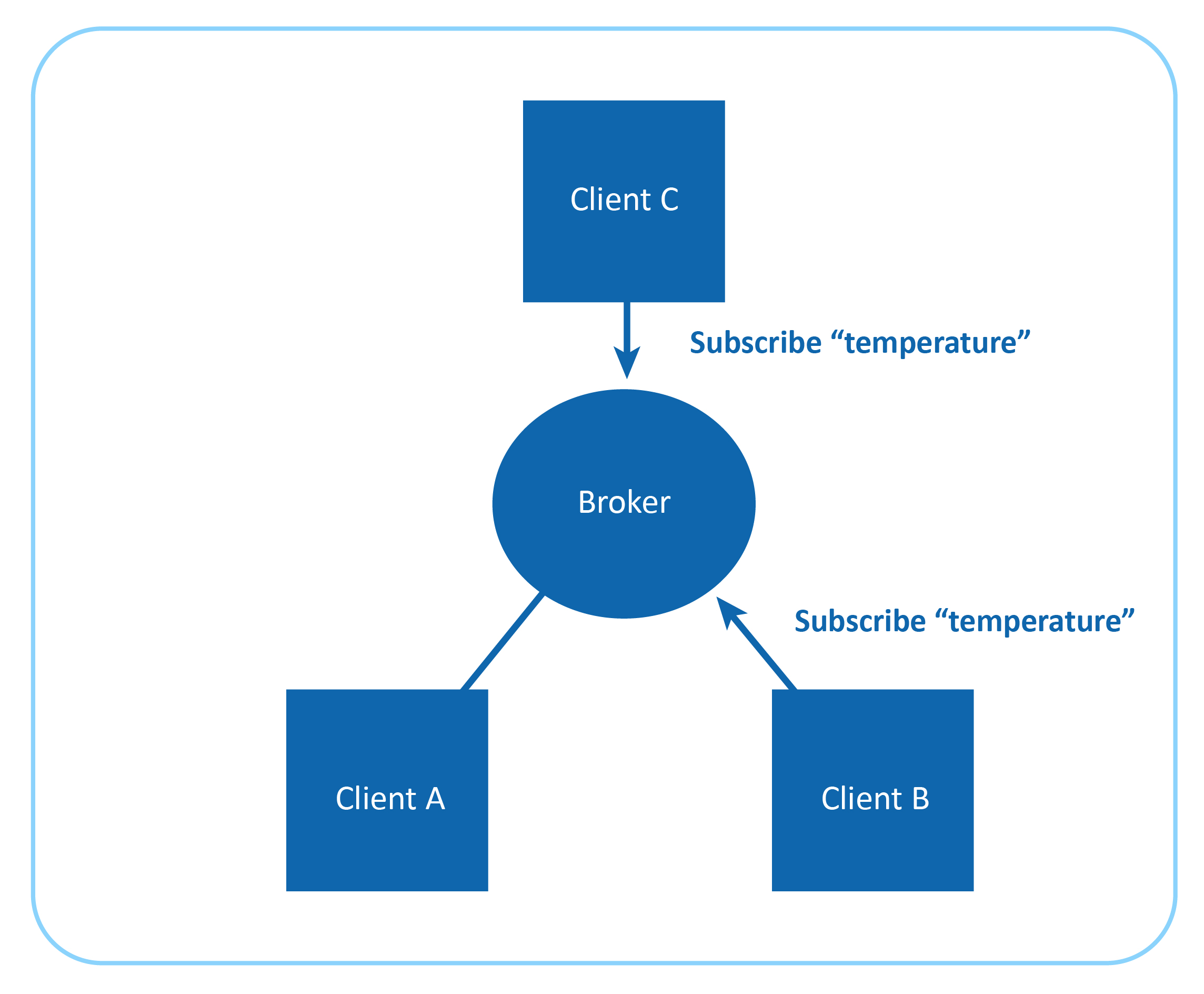
MQTT Protocol architecture

Client-A publishes 34.5 for topic temperature. The broker identifies this and forwards this message to all the subscribers, which in this case are Client-B and Client-C.
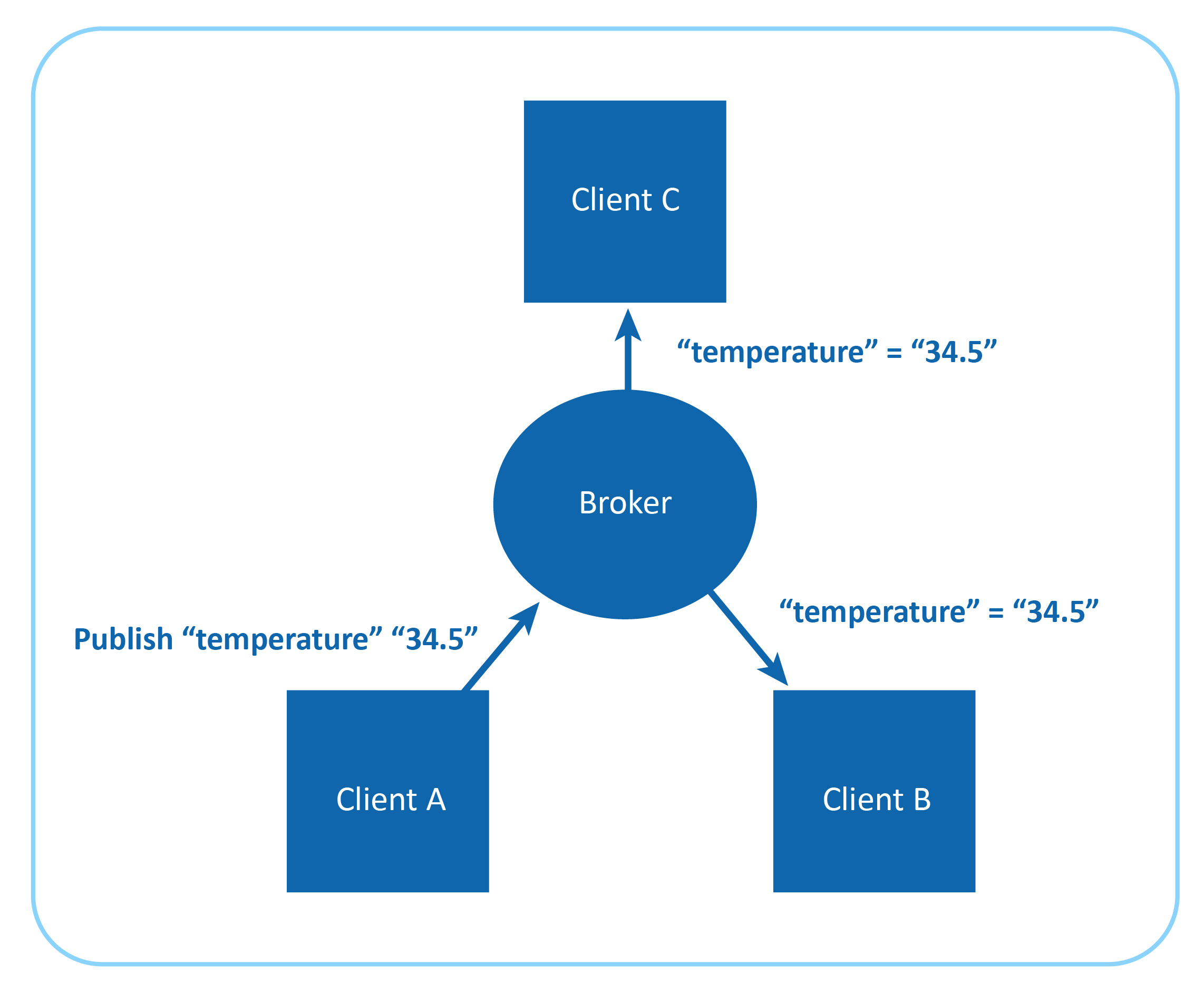
Working of MQTT protocol

The publisher-subscriber architecture of MQTT makes it a highly scalable solution, without creating dependencies between data producers and consumers.

Message format of MQTT protocol

All the messages of MQTT have a small code footprint, hence it is popular as a lightweight messaging protocol. Each MQTT message consists of the following:

  • Fixed header (2 bytes)
  • Optional variable header
  • Message payload (<= 256MB)
  • Quality of Service (QoS) level

MQTT supports one-to-one, one-to-many, and many-to-many communication.

By lowering the amount of data transmitted, MQTT makes itself a perfect protocol for constrained IoT devices.

Message payloads are encoded in binary. In an open network where the recipient is from a different manufacturer will face issues decoding it as there is no information of how message payload is encoded.

Quality of Service (QoS) level for MQTT protocol

The quality of service levels determines how the content is managed. MQTT uses three different QoS levels. It is important to choose the right QoS level for every message because it determines how the client and server communicate to deliver the message. The QoS levels of MQTT are as follows:

  • QoS 0 : Messages delivered per the best efforts of the operating environment, but message loss can occur
  • QoS 1 : Messages delivery assured but duplicates can be created
  • QoS 2 : Message to deliver exactly once

MQTT provides us with an option to set the appropriate QoS level, but remember, higher the QoS, lower the performance.

Security of MQTT protocol

MQTT allows you to pass username and password as an MQTT packet. Encryption of a message across the network can be handled independently of MQTT with Secure Sockets Layer (SSL). It has a minimal authentication feature built in. Username and password are sent as clear text. To make it secure, Secure Sockets Layer (SSL)/ Transport Layer Security (TLS) must be employed, but SSL/TLS is not a lightweight protocol.

Many industry experts believe MQTT will play a major role in IoT by contributing to fields such as inventory tracking, and medical IoT..

Subscribe to The HackerEarth Blog

Get expert tips, hacks, and how-tos from the world of tech recruiting to stay on top of your hiring!

Author
Vasudhendra Badami
Calendar Icon
December 21, 2016
Timer Icon
3 min read
Share

Hire top tech talent with our recruitment platform

Access Free Demo
Related reads

Discover more articles

Gain insights to optimize your developer recruitment process.

What It Takes to Keep Gen Z Engaged and Growing at Work

What It Takes to Keep Gen Z Engaged and Growing at Work

Engaging Gen Z employees is no longer an HR checkbox. It's a competitive advantage.

Companies that get this right aren’t just filling roles. They’re building future-ready teams, deepening loyalty, and winning the talent market before competitors even realize they’re losing it.

Why Gen Z is Rewriting the Rules

Gen Z didn’t just enter the workforce. They arrived with a different operating system.

  • They’ve grown up with instant access, real-time feedback, and limitless choice. When work feels slow, rigid, or disconnected, they don’t wait it out. They move on. Retention becomes a live problem, not a future one.
  • They expect technology to be intuitive and fast, communication to be direct and low-friction, and their employer to reflect values in daily action, not just annual reports.

The consequence: Outdated systems and poor employee experiences don’t just frustrate Gen Z. They accelerate attrition.

Millennials vs Gen Z: Similar Generation, Different Expectations

These two cohorts are often grouped together. They shouldn’t be.

The distinction matters because solutions designed for Millennials often fall flat for Gen Z. Understanding who you’re designing for is where effective engagement strategy begins.

Gen Z’s Relationship with Loyalty

Loyalty, for Gen Z, is earned, not assumed.

  • They challenge outdated processes and push for tech-enabled workflows.
  • They constantly evaluate whether their current role offers the growth, flexibility, and purpose they need. If it doesn’t, they start looking elsewhere.

Key insight: This isn’t disloyalty. It’s clarity about what they want. Organizations that align experiences with these expectations gain a competitive edge.

  • High turnover is the cost of ignoring this.
  • Stronger teams are the reward for getting it right.

What Actually Works

1. Rethink Workplace Technology

  • Outdated tools may be invisible to older employees, but Gen Z sees them immediately.
  • Modern HR tech and collaboration platforms improve efficiency and signal investment in people.
  • Invest in tools that reduce friction and enhance daily experience, not just track performance.

2. Flexibility with Clear Accountability

  • Gen Z values autonomy, but also needs clarity to thrive.
  • Hybrid and remote models work when paired with well-defined goals and explicit ownership.
  • Focus on outcomes, not hours. Autonomy with accountability is a combination Gen Z respects.

3. Continuous Feedback, Not Annual Reviews

  • Annual performance reviews feel outdated. Gen Z expects real-time feedback loops.
  • Frequent, actionable feedback helps employees improve faster and signals that their growth matters.
  • Make feedback a weekly habit, not a twice-yearly event.

4. Make Growth Visible

  • If career paths aren’t clear, Gen Z won’t wait. They’ll look elsewhere.
  • Internal mobility, structured learning paths, and reskilling opportunities signal future potential.
  • Invest in learning and development and make career trajectories explicit.

5. Build Real Belonging

  • Inclusion must show up in daily interactions, not just company values documents.
  • Inclusive environments where diverse perspectives are genuinely sought produce better decisions and stronger engagement.
  • Gen Z quickly notices when DEI is performative. Build it into everyday interactions.

6. Connect Work to Purpose

  • Gen Z wants to see how their work matters in a direct, traceable way.
  • Linking individual roles to tangible business outcomes increases ownership and engagement.
  • Purpose-driven work isn’t a perk. It’s a retention strategy.

7. Prioritize Well-Being

  • Burnout is a performance problem before it becomes attrition.
  • Mental health support, sustainable workloads, and genuine flexibility reduce stress and sustain engagement.
  • Policies must be real in practice. Gaps erode trust.

How to Attract Gen Z from the Start

Job Descriptions That Tell the Truth

  • Generic postings don’t convert Gen Z candidates. They want specifics: remote or hybrid expectations, real growth opportunities, and culture in practice.
  • Transparent job descriptions attract better-fit candidates and reduce early attrition.

Skills Over Experience

  • Gen Z and organizations hiring them increasingly value potential over tenure.
  • Skills-based hiring opens access to a broader, more diverse talent pool and builds teams equipped for change.
  • Hire for capability and future-readiness, not just years on a resume.

The Bottom Line

Retaining Gen Z isn’t about perks. It’s about rethinking the employee experience from the ground up.

  • Flexibility without accountability fails.
  • Purpose without visibility is hollow.
  • Growth that isn’t visible or structured drives attrition faster than most organizations realize.

The payoff: When organizations combine the right technology, real flexibility, continuous feedback, visible growth paths, and genuine inclusion:

  • Gen Z doesn’t just stay. They perform at a higher level.
  • Adaptive, future-forward thinking compounds over time.

That’s what separates organizations that thrive in today’s talent market from those constantly replacing people who left for somewhere better.

AI Tools for HR Managers in 2026: What's Actually Working (And What Isn't)

AI Tools for HR Managers in 2026: What's Actually Working (And What Isn't)

The current state of AI adoption in HR
88% of HR leaders say their organizations have not yet realized significant business value from AI. That number is striking, given that 91% of CHROs now rank AI as their single top priority. The gap is not a technology problem it is an adoption and strategy problem. Most HR teams have added AI to their workflows in some form, but very few have moved past experimentation into real, measurable impact.

This guide is for HR managers who want to change that. Not a list of tools to bookmark and forget, but a clear-eyed look at where AI is delivering results in 2026, what separates the tools that work from the ones that don't, and how to actually use them.

The adoption gap that most HR leaders aren't talking about

AI is present but underutilized.
According to the SHRM State of AI in HR 2026 report, 62% of organizations use AI somewhere in their business. But only 11% have embedded AI into daily workflows, defined as more than 60% of employees using it daily. That is a significant divide and explains why so many AI investments feel underwhelming.

Managers experiment more than employees.
A July 2025 Gartner survey of 2,986 employees found that 46% of managers are experimenting with AI, compared to just 26% of employees. Most organizations encourage exploration but fail to provide the structure, expectations, or training needed to make AI stick. Only 7% of organizations give employees guidance on how to use the time AI saves them.

The result: wasted potential.
Workforces have access to powerful tools but no framework for using them strategically. AI becomes another tab open in the browser, rather than a fundamental shift in how work gets done.

The opportunity is real.
Organizations that have moved from experimentation to integration are seeing tangible outcomes:

  • AI-powered recruitment tools reduce time-to-hire by an average of 30 days.
  • AI automates up to 60% of routine HR tasks, saving employees five or more hours per week.
  • Predictive analytics reduces voluntary turnover by 22–28% in the first year of deployment.

Capturing this opportunity requires the right tools and the right strategy.

Why 2026 is different from every other year of "AI in HR"

1. Skills-based hiring has gone mainstream.
Josh Bersin's 2026 Talent Report found that 72% of companies are moving away from degree requirements in favor of skills-based evaluation. Gartner reports that 65% of enterprises are actively prioritizing it. The traditional resume is no longer the most reliable signal of candidate quality, especially in tech roles where the half-life of skills is just two years.

2. Agentic AI has arrived.
Earlier generations of HR AI could automate tasks or analyze data. Agentic AI can plan, act, and iterate across entire workflows without constant human direction. 48% of large companies have already adopted agentic AI in HR, with projections showing 327% growth by 2027. This is no longer experimental.

3. Regulatory pressure is real.
The EU AI Act now classifies hiring AI as high-risk, making transparency and audit trails a legal requirement. Any AI tool influencing hiring decisions must be explainable. Black-box systems are a compliance liability.

What separates genuinely useful HR AI tools from the rest

They augment judgment rather than replace it.
Great HR AI tools make professionals better at their jobs. They surface the right information at the right moment, flag unnoticed patterns, and reduce cognitive load. Tools that try to remove humans entirely create legal risk and distrust. 88% of HR leaders haven’t seen ROI largely because their tools automate the wrong things.

They generate actionable insight, not just output.
Predictive models identify at-risk employees six months before they leave, skills-gap analyses shape hiring plans before a role opens, and candidate matching highlights transferable potential. This is the difference between AI that saves time and AI that changes decisions.

They are transparent and explainable.
Employees trust AI-generated reviews twice as often when they understand the criteria. 67% of candidates accept AI screening as long as a human makes the final call and the process is explained. Transparency builds trust, drives adoption, and ensures compliance.

Top AI tools for HR managers in 2026

HireVue
Standard for AI-powered video interviews and structured candidate assessments at scale. Cuts time-to-hire by 50%, supports 40+ languages, and uses IO psychologist-vetted guides. Bias audits and deterministic algorithms ensure fairness. Ideal for regulated industries and high-volume hiring.

Eightfold AI
Built for skills-first talent strategy. Maps 1.6 billion career profiles to a skills graph, matching candidates on potential rather than keywords. Increases recruiter productivity by 50%+ and reduces diversity sourcing time by 85%. Best for large enterprises focused on internal mobility and workforce planning.

Workday
Comprehensive HR platform with agentic AI for workforce planning, analytics, and employee lifecycle management. Acquisition of HiredScore integrates AI recruiting orchestration. Suitable for organizations needing a single system for headcount planning to performance reviews.

Lattice
Focuses on employee performance and engagement. AI identifies growth patterns, surfaces feedback trends, and flags disengagement early. Predictive models detect at-risk employees six months in advance, enabling targeted retention strategies. Ideal for culture and retention-focused organizations.

HackerEarth
Covers full tech hiring lifecycle, from sourcing developers through hackathons to live technical interviews. OnScreen AI interview agent uses lifelike avatars for structured, bias-free interviews. Ensures verification and cheat-proof processes. Trusted by Google, Amazon, Microsoft, Barclays, and Walmart.

Moving from experimentation to impact: a practical framework

1. Start with one high-friction problem.
Automate workflows that cost the most time or cause the most inconsistency typically initial candidate screening. Measure outcomes to justify next investments.

2. Define success before deployment.
47% of CHROs haven’t established clear AI productivity metrics. Set baseline and target improvements: time-to-shortlist, quality-of-hire, recruiter hours per hire anything trackable.

3. Put managers in the loop.
AI adoption gaps are often a manager problem. Give managers specific use cases, integrate AI into workflows, and provide language to discuss it with their teams.

The bottom line

AI will not change HR’s fundamental nature it remains a people function requiring judgment, empathy, and context. What AI improves is:

  • The quality of information available for every decision.
  • The time HR teams spend on work that doesn’t require judgment.

Organizations getting ahead in 2026 are those that select the right tools for the right problems and give teams structure to use them effectively. That is where the real advantage lies.

How to Handle Conflict at Work

How to Handle Conflict at Work

HR leaders often hear the same concern: "Small issues are turning into big problems, and teams are getting harder to manage."

They’re right. Conflict isn’t new, but how it appears today is different. Teams move faster, deadlines are tighter, and the pressure to deliver is constant. Friction builds quickly, and what used to stay small now escalates before anyone notices.

Here’s what most teams miss: the same conflict slowing them down can also be the thing that makes them stronger.

How Small Issues Turn Into Big Problems

You’ve probably seen this pattern before.

It starts with a misunderstanding, a missed expectation, or a poorly communicated decision. Nothing major, just enough tension to create distance.

That tension rarely gets addressed. Instead, it turns into silence. People stop raising concerns, avoid difficult conversations, and begin working around each other instead of with each other.

Over time, silence becomes disengagement. Collaboration drops. Trust weakens. Performance slips, and there’s no single moment you can point to as the cause. You’re left wondering, "What actually went wrong here?"

The shift that changes everything: the best teams don’t avoid conflict. They address it early. Honest communication and neutral guidance turn potential problems into opportunities to strengthen teams.

Conflict Is More Predictable Than It Feels

Most workplace conflict comes from a few common triggers:

  • Miscommunication or lack of clarity
  • Unclear roles and ownership gaps
  • Differences in work styles or expectations
  • Pressure from deadlines and performance targets

Recognizing these patterns early makes conflict easier to manage and often preventable.

Step 1: Make It Easy to Speak Up Early

The biggest reason conflict escalates is silence.

People notice issues early but hesitate to raise them. Maybe they don’t feel safe. Maybe they think it’s not worth it. By the time it surfaces, it always is.

The fix is straightforward:

  • Create regular space for honest conversations
  • Normalize feedback outside formal reviews
  • Train managers to handle uncomfortable discussions confidently

When people speak early, problems stay small and solvable.

Step 2: Act Early It Only Gets Harder

Many teams wait, hoping issues will resolve themselves. Conflict doesn’t disappear.

Small issues become frustration. Frustration becomes disengagement. Disengagement becomes attrition.

The best HR teams act early, even when conversations aren’t perfect. Early action is always easier than late correction.

Step 3: Managers Decide How Most Conflicts End

Strong HR processes matter, but most conflicts begin with managers.

Many managers aren’t equipped to handle conflict well. They avoid it, rush it, or escalate too quickly.

What works:

  • Listen before reacting. Understand what’s happening before seeking a resolution.
  • Stay neutral under pressure. Avoid taking sides prematurely.
  • Give clear, specific feedback. Vague conversations leave both sides confused.

When managers get this right, most conflicts resolve before HR intervention is needed.

Step 4: Focus on What Happened, Not Who Someone Is

It’s easy to say, "They’re difficult to work with."

It’s more effective to say, "Here’s what happened and the impact it had."

This shift:

  • Reduces defensiveness
  • Keeps conversations objective
  • Leads to faster, more durable outcomes

People can change behaviors. They resist being labeled.

Step 5: Give People a Process They Can Trust

Uncertainty worsens conflict.

Employees ask: Who do I go to? What happens next? Will this be handled fairly?

If answers aren’t clear, people stay silent or escalate too late. A simple, transparent process builds confidence and encourages early action.

How to implement:

  • Document it
  • Communicate it
  • Ensure managers know it as well as HR

Where Things Usually Go Wrong

Even strong HR teams fall into common traps:

  • Ignoring early warning signs — hoping small issues resolve themselves
  • Taking sides too quickly — before understanding the full picture
  • Relying on policy over people — process matters, but relationships matter more
  • Focusing on blame instead of outcomes — conflict resolution isn’t about who’s right

The goal isn’t to assign fault. It’s to decide what works next.

The Bottom Line

Conflict isn’t going away. How you handle it is a choice.

Handled poorly: drains teams and erodes culture.
Handled well: builds trust, sharpens communication, and strengthens performance faster than most team-building initiatives.

The best workplaces aren’t conflict-free.
They are just better at navigating it than everyone else.

Top Products

Explore HackerEarth’s top products for Hiring & Innovation

Discover powerful tools designed to streamline hiring, assess talent efficiently, and run seamless hackathons. Explore HackerEarth’s top products that help businesses innovate and grow.
Frame
Hackathons
Engage global developers through innovation
Arrow
Frame 2
Assessments
AI-driven advanced coding assessments
Arrow
Frame 3
FaceCode
Real-time code editor for effective coding interviews
Arrow
Frame 4
L & D
Tailored learning paths for continuous assessments
Arrow
Get A Free Demo