We are excited to announce that HackerEarth has integrated with yet another ATS—Jobvite—to help recruiters get the best of HackerEarth Assessment. It is a comprehensive ATS that accelerates recruitment efforts with an easy-to-use interface.
HackerEarth and Jobvite: Benefits of the integration
Jobvite helps HackerEarth reach out, follow up, and maintain a connection with candidates at each step of the hiring process. Additionally, it helps recruiters and hiring managers advertise jobs, manage the recruiting process, and much more. Ready to learn how Jobvite improves the speed and quality of your talent acquisition? Let’s get started!
When integrated, you can:
Create any type of job requisition to fit your needs
You can create and add any type of job requisition to fit your business needs by tailoring attributes such as posting type, location, custom workflow, and more. You can also edit a requisition that you have created, as and when required.
Track job openings and prospective candidates
After you create a requisition, Jobvite automatically posts your job openings on the web. It allows recruiters and hiring managers to track a company's job openings as well as the candidates who apply to the company’s open positions.
Screen prospects quickly
The recruiter CRM organizes all your lead generation and sourcing results in one place. Additionally, the screening and ranking tools in Jobvite help recruiters identify the most qualified talent in a jiffy.
Map multiple HackerEarth tests to job requisition
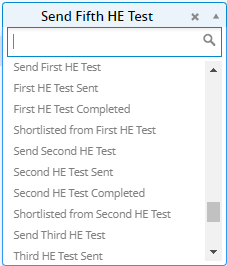
After a new requisition is added on the Jobvite platform, you can map a test to it via the recruiter API ID. You can create and add multiple tests and invite candidates to fill a job position (there is no upper limit on the number of candidates that you can test at a time). All this can be done directly from Jobvite’s interface.
Learn more about setting up assessments in Jobvite here.
View detailed candidate reports in the workflow setup
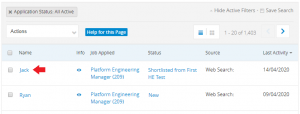
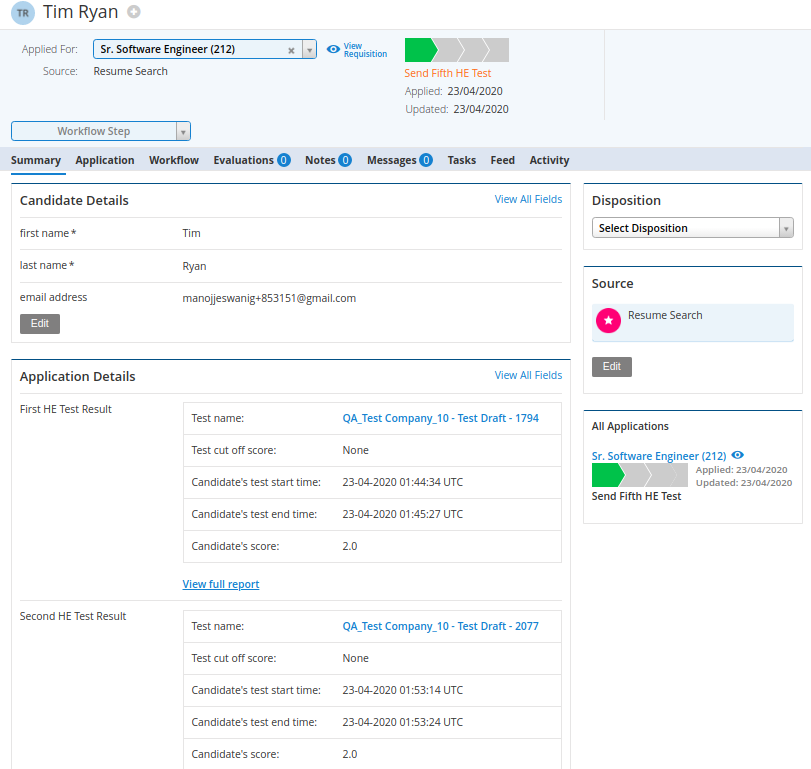
Hiring managers love having all candidate information saved in a single, easy-to-view record, while candidates are impressed by fast and informative responses from their potential employer. After candidates have completed the test, you can view their scores and other performance data in their Jobvite profile, making the selection process hassle-free. Additionally, if a candidate is shortlisted or rejected, the status is updated automatically in both Jobvite and HackerEarth platforms.
Jobvite has intelligence and automation built right in, making it efficient and easy to use for both recruiters and hiring managers. Try the Jobvite integration with HackerEarth and let us know how it works for you. If you need any help using this feature, write to us at support@hackerearth.com. If you’re new to HackerEarth and want to create accurate skill-based developer assessments, sign up for a 14-day free trial.
Subscribe to The HackerEarth Blog
Get expert tips, hacks, and how-tos from the world of tech recruiting to stay on top of your hiring!
Thank you for subscribing!
We're so pumped you're here! Welcome to the most amazing bunch that we are, the HackerEarth community. Happy reading!
A New Era of CodeVibe coding is a new method of using natural language prompts and AI tools to generate code. I have seen firsthand that this change makes software more accessible to everyone. In the past, being able to produce functional code was a strong advantage for developers. Today,...
A New Era of Code
Vibe coding is a new method of using natural language prompts and AI tools to generate code. I have seen firsthand that this change makes software more accessible to everyone. In the past, being able to produce functional code was a strong advantage for developers. Today, when code is produced quickly through AI, the true value lies in designing, refining, and optimizing systems. Our role now goes beyond writing code; we must also ensure that our systems remain efficient and reliable.
From Machine Language to Natural Language
I recall the early days when every line of code was written manually. We progressed from machine language to high-level programming, and now we are beginning to interact with our tools using natural language. This development does not only increase speed but also changes how we approach problem solving. Product managers can now create working demos in hours instead of weeks, and founders have a clearer way of pitching their ideas with functional prototypes. It is important for us to rethink our role as developers and focus on architecture and system design rather than simply on typing c
The Promise and the Pitfalls
I have experienced both sides of vibe coding. In cases where the goal was to build a quick prototype or a simple internal tool, AI-generated code provided impressive results. Teams have been able to test new ideas and validate concepts much faster. However, when it comes to more complex systems that require careful planning and attention to detail, the output from AI can be problematic. I have seen situations where AI produces large volumes of code that become difficult to manage without significant human intervention.
AI-powered coding tools like GitHub Copilot and AWS’s Q Developer have demonstrated significant productivity gains. For instance, at the National Australia Bank, it’s reported that half of the production code is generated by Q Developer, allowing developers to focus on higher-level problem-solving . Similarly, platforms like Lovable enable non-coders to build viable tech businesses using natural language prompts, contributing to a shift where AI-generated code reduces the need for large engineering teams. However, there are challenges. AI-generated code can sometimes be verbose or lack the architectural discipline required for complex systems. While AI can rapidly produce prototypes or simple utilities, building large-scale systems still necessitates experienced engineers to refine and optimize the code.
The Economic Impact
The democratization of code generation is altering the economic landscape of software development. As AI tools become more prevalent, the value of average coding skills may diminish, potentially affecting salaries for entry-level positions. Conversely, developers who excel in system design, architecture, and optimization are likely to see increased demand and compensation. Seizing the Opportunity
Vibe coding is most beneficial in areas such as rapid prototyping and building simple applications or internal tools. It frees up valuable time that we can then invest in higher-level tasks such as system architecture, security, and user experience. When used in the right context, AI becomes a helpful partner that accelerates the development process without replacing the need for skilled engineers.
This is revolutionizing our craft, much like the shift from machine language to assembly to high-level languages did in the past. AI can churn out code at lightning speed, but remember, “Any fool can write code that a computer can understand. Good programmers write code that humans can understand.” Use AI for rapid prototyping, but it’s your expertise that transforms raw output into robust, scalable software. By honing our skills in design and architecture, we ensure our work remains impactful and enduring. Let’s continue to learn, adapt, and build software that stands the test of time.
Ready to streamline your recruitment process? Get a free demo to explore cutting-edge solutions and resources for your hiring needs.
What is Systems Design?Systems Design is an all encompassing term which encapsulates both frontend and backend components harmonized to define the overall architecture of a product.Designing robust and scalable systems requires a deep understanding of application, architecture and their underlying components like networks, data, interfaces and modules.Systems Design, in its...
What is Systems Design?
Systems Design is an all encompassing term which encapsulates both frontend and backend components harmonized to define the overall architecture of a product.
Designing robust and scalable systems requires a deep understanding of application, architecture and their underlying components like networks, data, interfaces and modules.
Systems Design, in its essence, is a blueprint of how software and applications should work to meet specific goals. The multi-dimensional nature of this discipline makes it open-ended – as there is no single one-size-fits-all solution to a system design problem.
What is a System Design Interview?
Conducting a System Design interview requires recruiters to take an unconventional approach and look beyond right or wrong answers. Recruiters should aim for evaluating a candidate’s ‘systemic thinking’ skills across three key aspects:
How they navigate technical complexity and navigate uncertainty How they meet expectations of scale, security and speed How they focus on the bigger picture without losing sight of details
This assessment of the end-to-end thought process and a holistic approach to problem-solving is what the interview should focus on.
What are some common topics for a System Design Interview
System design interview questions are free-form and exploratory in nature where there is no right or best answer to a specific problem statement. Here are some common questions:
How would you approach the design of a social media app or video app?
What are some ways to design a search engine or a ticketing system?
How would you design an API for a payment gateway?
What are some trade-offs and constraints you will consider while designing systems?
What is your rationale for taking a particular approach to problem solving?
Usually, interviewers base the questions depending on the organization, its goals, key competitors and a candidate’s experience level.
For senior roles, the questions tend to focus on assessing the computational thinking, decision making and reasoning ability of a candidate. For entry level job interviews, the questions are designed to test the hard skills required for building a system architecture.
The Difference between a System Design Interview and a Coding Interview
If a coding interview is like a map that takes you from point A to Z – a systems design interview is like a compass which gives you a sense of the right direction.
Here are three key difference between the two:
Coding challenges follow a linear interviewing experience i.e. candidates are given a problem and interaction with recruiters is limited. System design interviews are more lateral and conversational, requiring active participation from interviewers.
Coding interviews or challenges focus on evaluating the technical acumen of a candidate whereas systems design interviews are oriented to assess problem solving and interpersonal skills.
Coding interviews are based on a right/wrong approach with ideal answers to problem statements while a systems design interview focuses on assessing the thought process and the ability to reason from first principles.
How to Conduct an Effective System Design Interview
One common mistake recruiters make is that they approach a system design interview with the expectations and preparation of a typical coding interview. Here is a four step framework technical recruiters can follow to ensure a seamless and productive interview experience:
Step 1: Understand the subject at hand
Develop an understanding of basics of system design and architecture
Familiarize yourself with commonly asked systems design interview questions
Read about system design case studies for popular applications
Structure the questions and problems by increasing magnitude of difficulty
Step 2: Prepare for the interview
Plan the extent of the topics and scope of discussion in advance
Clearly define the evaluation criteria and communicate expectations
Quantify constraints, inputs, boundaries and assumptions
Establish the broader context and a detailed scope of the exercise
Step 3: Stay actively involved
Ask follow-up questions to challenge a solution
Probe candidates to gauge real-time logical reasoning skills
Make it a conversation and take notes of important pointers and outcomes
Guide candidates with hints and suggestions to steer them in the right direction
Step 4: Be a collaborator
Encourage candidates to explore and consider alternative solutions
Work with the candidate to drill the problem into smaller tasks
Provide context and supporting details to help candidates stay on track
Ask follow-up questions to learn about the candidate’s experience
Technical recruiters and hiring managers should aim for providing an environment of positive reinforcement, actionable feedback and encouragement to candidates.
Evaluation Rubric for Candidates
Facilitate Successful System Design Interview Experiences with FaceCode
FaceCode, HackerEarth’s intuitive and secure platform, empowers recruiters to conduct system design interviews in a live coding environment with HD video chat.
FaceCode comes with an interactive diagram board which makes it easier for interviewers to assess the design thinking skills and conduct communication assessments using a built-in library of diagram based questions.
With FaceCode, you can combine your feedback points with AI-powered insights to generate accurate, data-driven assessment reports in a breeze. Plus, you can access interview recordings and transcripts anytime to recall and trace back the interview experience.
Learn how FaceCode can help you conduct system design interviews and boost your hiring efficiency.
Impact of Online Assessments in Technical Hiring
In a digitally-native hiring landscape, online assessments have proven to be both a boon and a bane for recruiters and employers.
The ease and...
Impact of Online Assessments in Technical Hiring
In a digitally-native hiring landscape, online assessments have proven to be both a boon and a bane for recruiters and employers.
The ease and efficiency of virtual interviews, take home programming tests and remote coding challenges is transformative. Around 82% of companies use pre-employment assessments as reliable indicators of a candidate's skills and potential.
Online skill assessment tests have been proven to streamline technical hiring and enable recruiters to significantly reduce the time and cost to identify and hire top talent.
In the realm of online assessments, remote assessments have transformed the hiring landscape, boosting the speed and efficiency of screening and evaluating talent. On the flip side, candidates have learned how to use creative methods and AI tools to cheat in tests.
As it turns out, technology that makes hiring easier for recruiters and managers - is also their Achilles' heel.
Cheating in Online Assessments is a High Stakes Problem
With the proliferation of AI in recruitment, the conversation around cheating has come to the forefront, putting recruiters and hiring managers in a bit of a flux.
The problem becomes twofold - if finding the right talent can be a competitive advantage, the consequences of hiring the wrong one can be equally damaging and counter-productive.
As per Forbes, a wrong hire can cost a company around 30% of an employee's salary - not to mention, loss of precious productive hours and morale disruption.
The question that arises is - "Can organizations continue to leverage AI-driven tools for online assessments without compromising on the integrity of their hiring process? "
This article will discuss the common methods candidates use to outsmart online assessments. We will also dive deep into actionable steps that you can take to prevent cheating while delivering a positive candidate experience.
Common Cheating Tactics and How You Can Combat Them
Using ChatGPT and other AI tools to write code
Copy-pasting code using AI-based platforms and online code generators is one of common cheat codes in candidates' books. For tackling technical assessments, candidates conveniently use readily available tools like ChatGPT and GitHub.
Using these tools, candidates can easily generate solutions to solve common programming challenges such as:
Debugging code
Optimizing existing code
Writing problem-specific code from scratch
Ways to prevent it
Enable full-screen mode
Disable copy-and-paste functionality
Restrict tab switching outside of code editors
Use AI to detect code that has been copied and pasted
Enlist external help to complete the assessment
Candidates often seek out someone else to take the assessment on their behalf. In many cases, they also use screen sharing and remote collaboration tools for real-time assistance.
In extreme cases, some candidates might have an off-camera individual present in the same environment for help.
Ways to prevent it
Verify a candidate using video authentication
Restrict test access from specific IP addresses
Use online proctoring by taking snapshots of the candidate periodically
Use a 360 degree environment scan to ensure no unauthorized individual is present
Using multiple devices at the same time
Candidates attempting to cheat often rely on secondary devices such as a computer, tablet, notebook or a mobile phone hidden from the line of sight of their webcam.
By using multiple devices, candidates can look up information, search for solutions or simply augment their answers.
Ways to prevent it
Track mouse exit count to detect irregularities
Detect when a new device or peripheral is connected
Use network monitoring and scanning to detect any smart devices in proximity
Conduct a virtual whiteboard interview to monitor movements and gestures
Using remote desktop software and virtual machines
Tech-savvy candidates go to great lengths to cheat. Using virtual machines, candidates can search for answers using a secondary OS while their primary OS is being monitored.
Remote desktop software is another cheating technique which lets candidates give access to a third-person, allowing them to control their device.
With remote desktops, candidates can screen share the test window and use external help.
Ways to prevent it
Restrict access to virtual machines
AI-based proctoring for identifying malicious keystrokes
Use smart browsers to block candidates from using VMs
Future-proof Your Online Assessments With HackerEarth
HackerEarth's AI-powered online proctoring solution is a tested and proven way to outsmart cheating and take preventive measures at the right stage.
With HackerEarth's Smart Browser, recruiters can mitigate the threat of cheating and ensure their online assessments are accurate and trustworthy.
Secure, sealed-off testing environment
AI-enabled live test monitoring
Enterprise-grade, industry leading compliance
Built-in features to track, detect and flag cheating attempts
Boost your hiring efficiency and conduct reliable online assessments confidently with HackerEarth's revolutionary Smart Browser.
Top Products
Explore HackerEarth’s top products for Hiring & Innovation
Discover powerful tools designed to streamline hiring, assess talent efficiently, and run seamless hackathons. Explore HackerEarth’s top products that help businesses innovate and grow.