


Get in touch with our friendly team and we’ll get back to you soon.
Book a demoAn AI interviewer for technical screening is software that conducts structured, role-calibrated technical interviews with candidates usually through voice or video and scores their responses against a fixed rubric. It sits between the resume review and the human panel, doing the work that senior engineers used to do at 4pm on a Friday: asking coding questions, probing on reasoning, and deciding who deserves a live conversation.
The category has moved fast in the last 18 months. What was a chatbot filling out a scorecard in 2023 is now, at its better end, a video-avatar interviewer that holds a two-way conversation, watches the candidate write code, and verifies identity before starting.
The rest of this piece explains how an AI interviewer for technical screening actually works, what it evaluates well, where it fails, and how to decide whether it belongs in your hiring stack.
An AI interviewer for technical screening is an automated system that runs a structured technical interview coding, system design, or role-specific questions without a human interviewer present. It uses a large language model plus a rubric to ask questions, follow up on candidate answers, evaluate responses, and produce a scored report.
The point of an AI interviewer for technical screening is not to replace human judgment on culture, seniority, or hiring conviction. It is to remove the scheduling friction, calibration drift, and senior-engineer time cost from the first 30–60 minutes of the interview process.
The flow is roughly consistent across the serious platforms:
The interview typically runs 30–60 minutes. Better platforms adapt follow-ups based on what the candidate says; weaker ones read from a script and evaluate against keyword matches.
Three structural problems in technical hiring made the category inevitable.
Volume outstripped capacity. A mid-size product company running 40 engineering reqs at once cannot get senior engineers to do first-round screens without slowing shipping. IT services firms running campus programs at 50,000+ candidates a year cannot do it at all with humans.
AI-generated CVs broke resume signal. By 2024, recruiters were anecdotally reporting cover letters and resumes that were obviously generated, and take-home submissions that didn't match the candidate's actual ability once they reached a live conversation. The first-round conversation became load-bearing in a way it hadn't been before and there were too many of them to run. This is the problem AI-generated CVs create for technical hiring, and the reason the live conversation matters more now than it used to.
Scheduling was quietly losing candidates. A strong developer who applies on Thursday evening and gets a Monday morning email is often gone by Tuesday. Async, always-on screening addresses this directly.
None of these problems is new. What changed is that the tooling caught up enough to make the trade-off worth it for a growing set of use cases.
An AI interviewer for technical screening evaluates skills that show up in structured, observable behavior: coding correctness, algorithmic reasoning, language fluency, communication of technical concepts, and with the right question design approach to ambiguity.
Concretely, a well-configured system can assess:
What it evaluates poorly: seniority judgment on ambiguous design questions, cultural signals that require reading the room, and the "would I want to work with this person" question. These belong in a human round.
The category handles three interview formats well and one badly.
Handled well: structured coding interviews (medium-difficulty algorithmic questions with a clear rubric), language- or framework-specific technical Q&A, and role-based screens for adjacent technical roles like data analysts, SDETs, and backend engineers up to mid-level.
Handled with caveats: system design interviews. The better platforms give candidates a drawing canvas and let the AI probe on scalability, trade-offs, and reasoning. But senior system design the kind you'd run for a staff-level hire still benefits from a human who can push back with context the AI doesn't have. For a fuller picture of where AI interviews work and where they don't by role and seniority, it's worth mapping the tool to the level you're hiring for before rolling it out.
Handled badly: open-ended senior conversations where the goal is calibration on judgment, past decisions, and technical taste. If you're hiring a principal engineer, use the AI interviewer to filter noise from the top of the funnel, not to make the hire/no-hire call.
The most common configuration is a three-stage funnel: skills assessment → AI interview → human panel.
The assessment filters for baseline coding ability at high volume 500 applicants down to 100. The AI interview does the structured conversational screen 100 down to 20. The human panel does the deep technical evaluation and hire decision 20 down to offer.
Some teams skip the assessment stage and go straight to AI interview when the top-of-funnel volume is manageable. Others use the AI interview as the second-round after a recruiter phone screen, replacing what used to be the "junior engineer does a 45-minute technical screen" step. The right configuration depends on volume, seniority, and how much senior engineer time you're currently burning on screens.
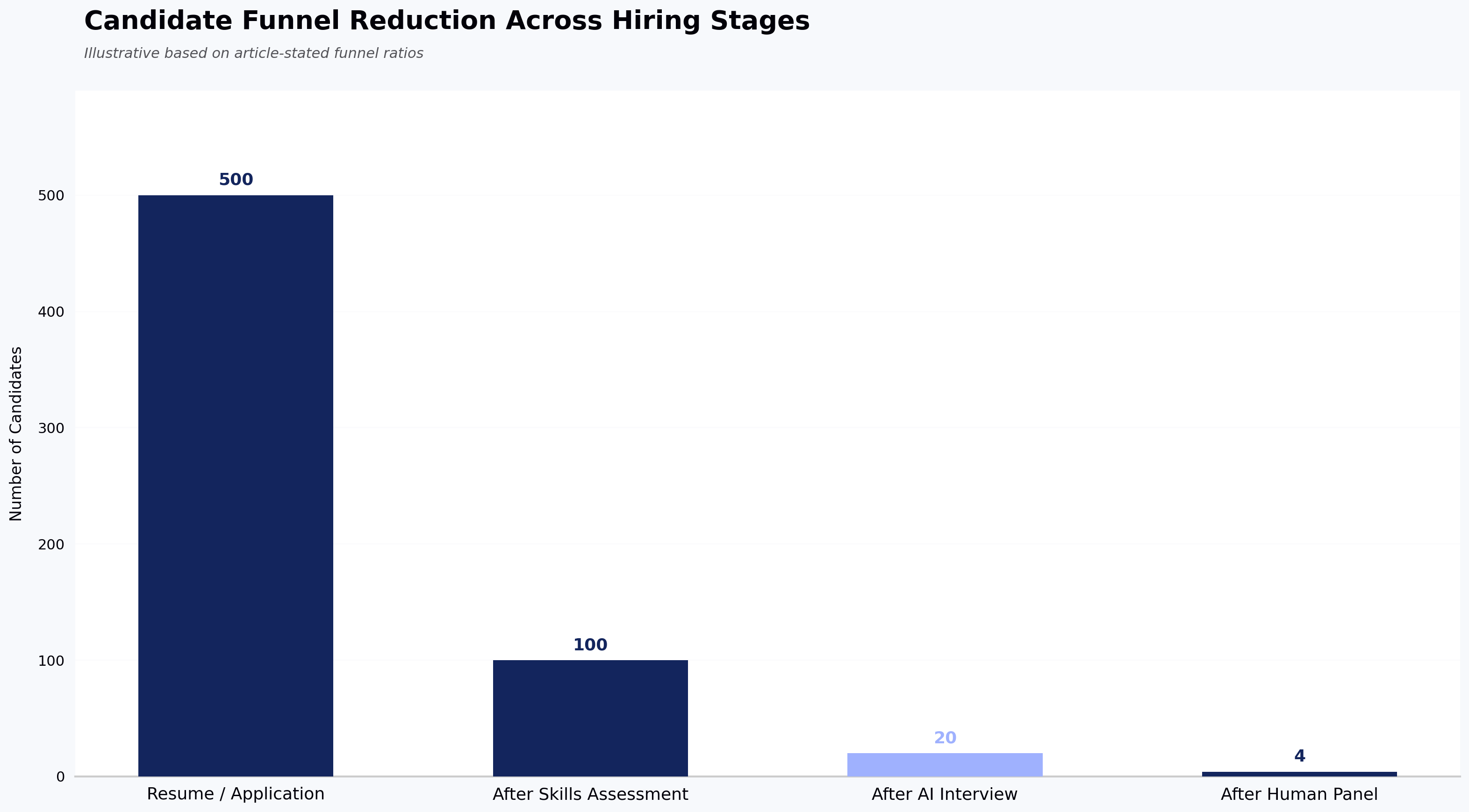
Source: Illustrative based on article-stated funnel ratios
The evaluation combines three signals: correctness, complexity, and reasoning quality.
The benefits fall into four buckets: time, consistency, coverage, and signal.
The trade-off is real: you lose the recruiter's gut read on the candidate, the informal conversation that sometimes surfaces a great hire the rubric would have missed, and the employer-brand touch of a warm human first contact.
Teams that value those things heavily should keep the human phone screen and use the AI interviewer later in the funnel.
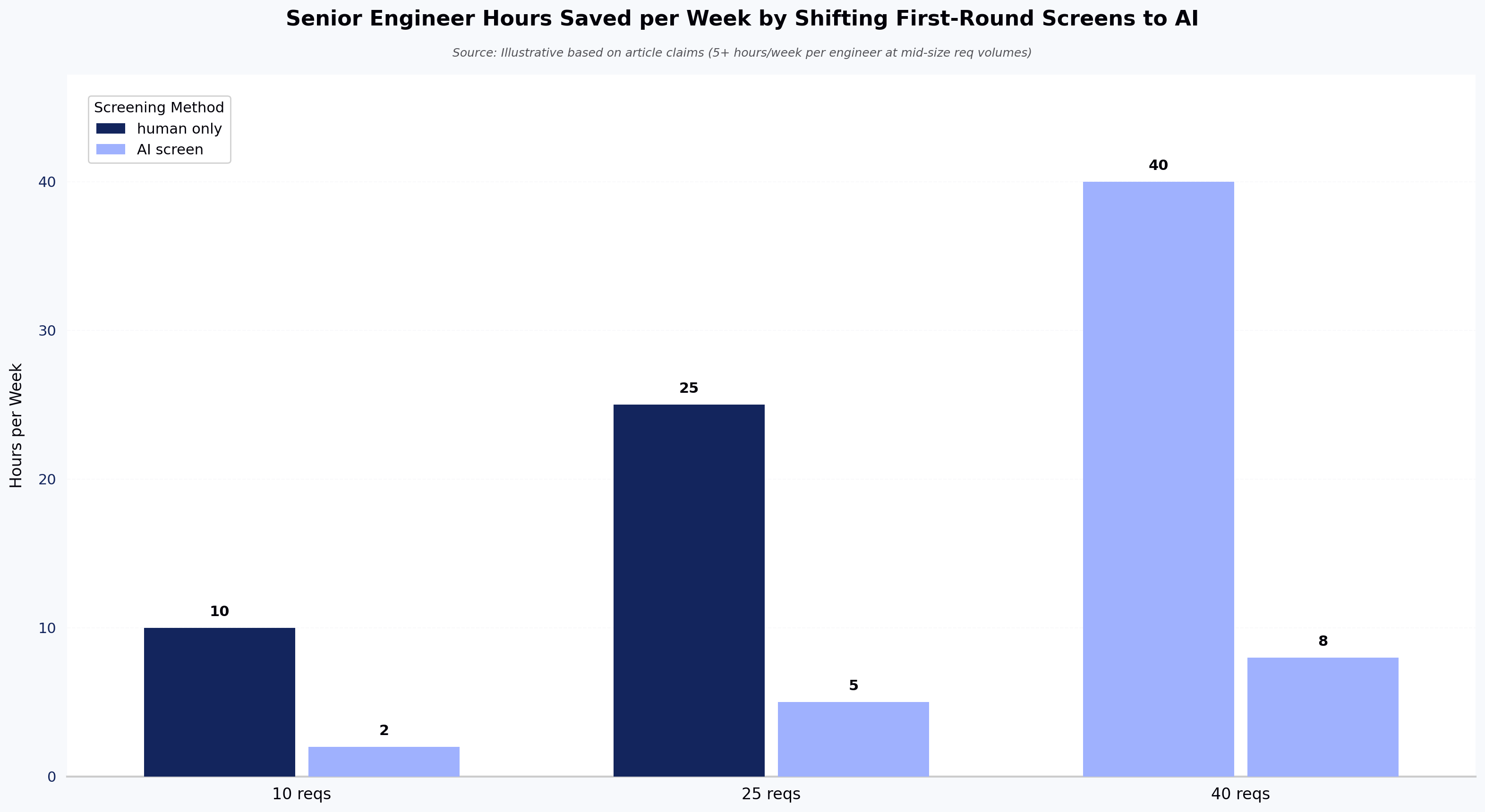
Source: Illustrative based on article claims (5+ hours/week per engineer at mid-size req volumes)
The clean distinction: a traditional technical interview is optimized for judgment, an AI interviewer is optimized for filtering.
A traditional first-round technical interview with a human costs 45–60 minutes of a senior engineer's time, produces a subjective assessment shaped by that specific interviewer's calibration, and happens on a schedule that suits the interviewer. Its strength is that the interviewer can follow an unexpected thread, adjust based on the candidate's background, and make a hire/no-hire call informed by things the rubric doesn't cover.
An AI interviewer for technical screening costs no engineer time, produces a scored assessment against a fixed rubric, and runs when the candidate is ready. Its strength is consistency at scale. Its weakness is exactly what makes the human version strong it doesn't follow unexpected threads well, and it can't make judgment calls that require context outside the rubric.
The right answer is almost never "one or the other." It's "AI interviewer first, human panel for the candidates who pass."
Six features separate serious AI interviewers for technical screening from the noise: identity verification, genuine two-way conversation, deterministic rubric application, language and role coverage, proctoring that doesn't punish honest candidates, and ATS integration.
At scale, the AI interviewer stops being a convenience and becomes structural. IT services firms running campus programs and product companies with global req pipelines face the same math: they need to screen more candidates than any interviewer team can absorb.
As a benchmark on scale: enterprise deployments have run thousands of rubric-applied screens in a single weekend - a throughput no human panel can match. The relevant comparison isn't "AI interview vs. human interview" it's "AI interview vs. no screen at all, applicants filtered by resume keyword match." The second is what most high-volume programs actually did before, and it produced worse hires than a rubric-applied AI screen.
The scale angle also matters for campus and pyramid-heavy hiring in IT services, where a large share of intake comes through campus programs and consistency across thousands of evaluations is the whole problem.
Consistency comes from two properties: fixed rubric and no interviewer variance.
Every candidate is asked from the same question pool, scored against the same criteria, and evaluated by the same model. A candidate interviewed at 3am gets the same experience as one interviewed at 3pm. A candidate interviewed by "the AI" gets the same evaluation as another candidate interviewed by "the AI" not the wildly different assessments you get when Panel A includes the strict staff engineer and Panel B includes the founder who likes everyone.
This matters for three reasons: it makes calibration easier (the rubric is the only thing to argue about), it makes defensibility stronger under audit or litigation, and it produces cleaner data for quality-of-hire analysis six months later. Rubric-applied evaluation isn't zero bias - AI systems have their own bias profiles but it is more consistent across candidates than human-led screens.
Four limits are worth naming honestly.
Three questions decide the choice.
Run a paid pilot against a real requisition, not a demo. Measure quality-of-hire six months later, not just recruiter satisfaction at week one.
For some senior candidates, yes - it signals that the company doesn't value the early conversation enough to have a human do it. For most junior and mid-level candidates, it's neutral or positive, especially when the alternative is waiting two weeks for a human slot. The red flag is not the AI interview itself; it's an AI interview with no human contact anywhere in the process.
It depends on which side of the interview you're on. For candidates preparing for interviews, tools like MockAI, interviewing.io's practice mode, and HackerRank's mock interview product are the common choices. For employers screening candidates -the focus of this article - HackerEarth's OnScreen combines in-depth interviewing, integrated proctoring, and KYC verification in a single flow aimed at enterprise technical hiring. Interviewer.AI focuses on asynchronous video interviews with a broader non-technical role mix, which suits teams screening across business and technical functions. Match the tool to your volume, seniority mix, and integration needs not to a leaderboard.
Treat it like a real technical interview, because it is one. Think aloud, ask clarifying questions before writing code, handle edge cases explicitly, and explain your reasoning. The AI is scoring communication and problem-solving approach, not just correctness candidates who code silently score worse than candidates who narrate.
This is the calibration case worth watching. If it happens once, it's noise. If it happens repeatedly with the same rubric, either the rubric doesn't match what the hiring manager actually values, or the AI is scoring surface signals the human panel discounts. The fix is to review the rubric with the hiring manager against the rejected candidates' transcripts not to lower trust in the AI screen or the panel in isolation. Vendors who can't show you the transcript and score breakdown make this loop impossible to close.
Weaker platforms without identity verification and live-coding observation are gameable. Serious platforms with KYC-grade ID checks, proctoring, and live code editors that watch for large paste events are meaningfully harder to cheat than take-home assignments were. The gap is not zero, but it's smaller than the pre-AI baseline.
No, and vendors who claim they do are overselling. The right model is AI for structured screening, human for judgment-heavy rounds and the hire decision. For engineers, this means fewer hours on early screens. For recruiters, pipelines move faster. For candidates, the experience is consistent and skills-first, regardless of when they apply.
The decision framework above match tool to volume and seniority, weigh defensibility, check integration fit only resolves against a real requisition. If you're evaluating AI interviewers for an actual hiring program rather than researching the category, the fastest way to judge fit is to run one against a live role.
Schedule a demo of HackerEarth OnScreen to see how structured AI interviews, identity verification, and rubric-based evaluation work together on a role you're actually hiring for.
An AI interviewer for software engineer screening is software that conducts a structured technical interview coding, system design, or role-specific questions without a human on the other side of the call. Anecdotally, the category has moved from novelty to line item in a growing number of technical hiring stacks over roughly the past 18 months, driven by two commonly cited forces: senior engineer time is expensive, and recruiters report that resume signal has weakened as AI-generated CVs become more common.
This article compares 10 tools that companies are actually using for AI interviewer software engineer screening in production hiring pipelines. Not every tool fits every team.
The differences that matter are less about which one has flashier avatars and more about how each handles rubric consistency, identity verification, and the specific type of engineer you are hiring.
An AI interviewer for software engineer screening is an automated system that conducts a technical interview with a candidate usually asynchronously and returns a structured evaluation against a defined rubric. The best implementations do three things: ask calibrated follow-ups based on candidate responses, evaluate code in-session, and verify the candidate's identity so the person interviewed is the person being hired.
There are two broad categories.
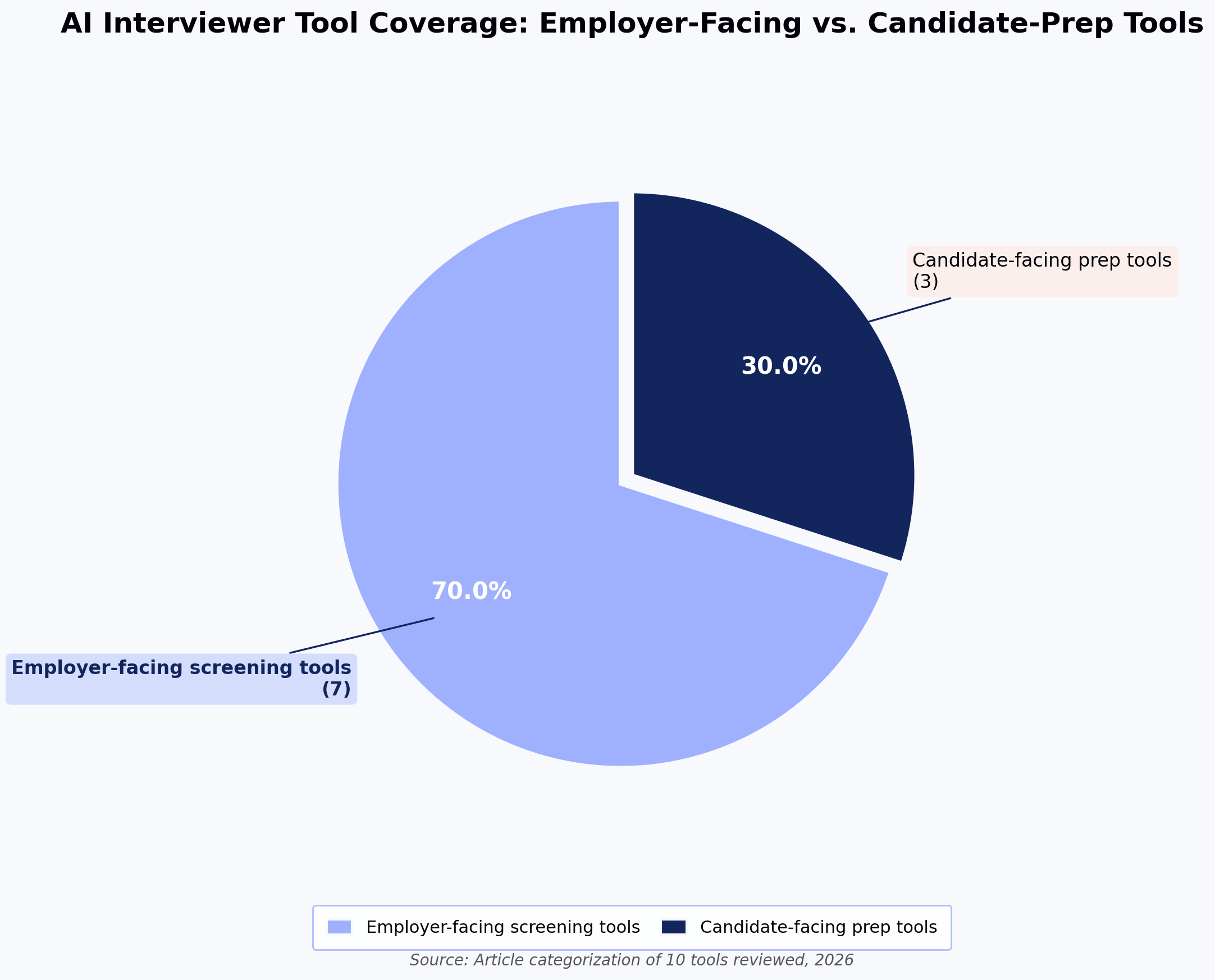
Source: Article categorization of 10 tools reviewed, 2026
The typical flow: a candidate receives a link, verifies their identity, and joins a session that combines conversational questions, coding tasks, and sometimes system design prompts. The AI adapts follow-up questions based on how the candidate answers probing depth on data structures, asking about trade-offs on system design, or requesting an explanation of the code the candidate just wrote.
Under the hood, most current tools are wrappers around a large language model with a coding sandbox, a proctoring layer, and a scoring rubric. The differences between products are usually not in the underlying model most use variants of GPT-4, Claude, or Gemini but in the rubric design, the question library, and the integrity layer. A well-designed rubric run on a mid-tier model beats a poor rubric run on the best model.
At a minimum: coding fluency in the languages the role requires, problem decomposition, ability to reason about edge cases, and communication of technical trade-offs. For senior roles, add system design, debugging under uncertainty, and the ability to defend a decision when the interviewer pushes back.
What AI interviewers do poorly today: culture fit, long-horizon collaboration signal, and judgment about ambiguous requirements. If those are the primary skills you are hiring for, an AI interview is a filter before the human panel, not a replacement for it. Any vendor claiming otherwise is oversold.
The strongest implementations run candidate code in a sandboxed environment, evaluate against hidden test cases, and score not just correctness but approach did the candidate think through edge cases before writing, or did they submit and hope? Some tools now analyze intermediate keystrokes and revision patterns, though signal from that data is mixed.
For problem-solving, the AI evaluates how the candidate responds when the initial approach fails a test case. A candidate who calmly diagnoses and refactors scores differently from one who guesses at fixes. This is where AI interviewers can outperform inconsistent human interviewers — the rubric applies the same way at 3 PM Tuesday as it does at 11 PM Sunday.
Three properties, in order of importance:
Tools that treat these as afterthoughts fail the "would I forward this report to the hiring manager" test.
The list below covers seven employer-facing screening tools and three candidate-prep tools engineers use to prepare for them. The comparative sections that follow focus on the employer-facing tools; candidate-prep tools are included so employers understand what candidates are practicing with. Positioning is drawn from each vendor's public materials as of 2026; verify current pricing and capabilities directly before procurement.
For a broader view of how these platforms stack up, see our comparison of AI interview agent platforms.
Employer-facing tools split into two camps on technical evaluation. HackerEarth OnScreen, CodeSignal AI Interviewer, and HackerRank's employer products draw on established coding assessment libraries - the question banks are deep and the scoring has been calibrated over years. Karat sits in its own category, combining trained human interview engineers with AI-native interview simulations.
Newer entrants often have thinner question libraries and rely more heavily on generating questions dynamically from role descriptions. This works well for common roles (backend, full-stack, frontend) and less well for specialized ones (embedded systems, ML infrastructure, low-level graphics). If you are hiring for something narrow, ask to see the actual question set before signing. For a role-by-role view of where AI interviews hold up, see why AI interviews are becoming standard practice in technical hiring.
The best tools evaluate more than pass/fail on test cases. They score approach, edge-case handling, and the candidate's ability to explain their code. CodeSignal AI Interviewer does this well. Karat's human interviewers still set the bar for probing follow-ups, at proportional cost.
Where all AI tools struggle: distinguishing a candidate who genuinely understands their code from one who wrote it with AI assistance and can plausibly narrate it. Integrity checks help, but the honest position is that this problem is not fully solved. Any vendor telling you they have solved it is overpromising.
Integrity has three components: identity, environment, and authorship of the code produced. HackerEarth OnScreen combines identity verification with in-session proctoring. Karat's human interviewers verify identity conversationally. HireVue and CodeSignal offer proctoring layers of varying depth.
Tools like Interview Coder - a candidate-side product that uses low-level graphics overlays to stay invisible to screen-sharing software are part of why integrity layers matter. No employer tool prevents a determined candidate with a second device from receiving external help; what good integrity does is raise the cost enough that the median candidate does not attempt it, and flag irregularities for human review. Treat integrity claims as risk reduction, not elimination.
Volume is where AI interviewers earn their budget. A team hiring 500 engineers a year, doing 3–5 initial screens per hire, is spending 5,000–10,000 senior engineer hours on early-stage interviews. Moving that to AI, even for the first round, is measured in engineer weeks reclaimed.
HackerEarth OnScreen was designed for this pattern, with rubric-applied evaluation that stays consistent across large candidate cohorts. Karat and CodeSignal also scale, though pricing math differs. Newer entrants often price per interview, which becomes expensive fast at IT services or campus hiring scale.
For high-volume contexts, three questions matter more than product features:

Source: Illustrative based on article claims (500 hires × 3–5 screens × ~1 hour per screen)
Non-negotiable: deterministic scoring, identity verification, ATS integration, candidate-visible time boundaries (nothing loses good candidates faster than an unbounded interview), and audit-ready reports for defensibility.
Nice-to-have: video avatars (they help engagement more than we expected), multi-language support if you hire globally, and role-specific rubric templates you can customize without vendor services. If you cannot edit the rubric yourself, calibration drift will become a real problem within six months.
Pricing models vary widely and vendors publish little. Broad patterns as of 2026:
These are rough market estimates based on publicly available positioning; vendors publish little firm pricing and figures should be verified directly.
The ROI math that matters is not cost per interview — it is cost per interview times volume, minus senior engineer hours reclaimed. Run that calculation with real numbers from your team before comparing sticker prices.
AI interviewers have four honest limitations that hiring teams should understand before committing.
Reddit threads on AI interviews reflect this candidate ambivalence some engineers see AI screens as fairer than inconsistent human ones, others see them as a red flag about the employer. Both reactions are defensible. The employer's job is to make sure the AI screen is one stage in a process that includes real humans, not the whole process.
Pick the tool that fits your hiring pattern, not the tool with the most features. A team hiring 20 senior engineers a year needs different things from a team hiring 5,000 freshers off campus.
For senior product engineering hiring, prioritize rubric depth, integrity, and integration with a live technical panel tool like FaceCode for live technical interviews for later stages. For high-volume campus or IT services hiring, prioritize throughput, cost per interview, and ATS integration. For regulated hiring (BFSI, government), prioritize defensibility, audit trails, and identity verification standards.
Pilot two tools with real candidates for at least four weeks before committing. Vendor demos show the tool at its best; a pilot shows it at its median. Newer entrants like Talently.ai and Micro1 in particular warrant a live pilot before committing, since feature depth and scoring calibration are still maturing.
Sometimes. Senior candidates with strong options may decline AI-only processes, particularly if the AI screen is the entire evaluation rather than the first stage. The mitigation is to be transparent about where the AI interview sits in your process and to ensure human interviewers own final decisions. Companies that use AI to save time at the top of funnel and invest that time in higher-quality later-stage interviews tend to see less pushback.
The same categories human interviewers ask: data structures and algorithms (arrays, hashmaps, trees, graphs), system design at appropriate seniority (design a URL shortener, design a rate limiter, design a distributed cache), debugging scenarios, and language-specific fundamentals. AI interviewers tend to lean on well-known problem patterns because scoring is more reliable there.
Start by defining what a passing answer looks like at each level for the same question - a junior candidate might earn full marks for a working brute-force solution with edge-case awareness, while a senior candidate needs to discuss trade-offs and scaling. Most calibration drift comes from applying one rubric across levels; separate rubrics per level, reviewed quarterly against hire outcomes, prevent the drift that makes AI interview reports lose credibility with hiring managers after six months.
Be explicit about three things before the invite: where the AI screen sits in the process, that human interviewers own final decisions, and how long the interview takes. Senior candidates decline AI-only processes most often when they suspect the AI screen is the entire evaluation. Companies that name the human stages upfront see materially lower drop-off than those that lead with the AI screen and leave the rest vague.
Partially. Integrity layers can catch obvious cases -multiple faces on camera, unusual audio patterns, tab switching. Sophisticated cases where a candidate uses a second device silently are harder to catch. The best defense is a rubric that probes understanding, not just correctness asking the candidate to modify their code, explain a trade-off, or debug an intentional bug reveals whether they wrote it.
Treat it like a structured technical screen with a strict time budget. Practice speaking through your approach before writing code (AI rubrics score reasoning, not just correctness), rehearse common patterns (arrays, hashmaps, trees, graphs, basic system design), and do at least one timed mock with a tool like interviewing.io or HackerRank AI Mock Interviews to get used to talking to an AI interviewer. Confirm your camera, microphone, and network before the session - most integrity flags come from environment issues, not intent.
If you are evaluating AI interviewers for software engineer screening, request a walkthrough of HackerEarth OnScreen with a candidate flow from your own pipeline. Bring a real role and a real rubric that is the only way to see whether the tool fits how your team actually hires.
The AI interviewer vs. human interviewer debate is not about accuracy. It is a debate about which stage of the funnel deserves human time. AI interviewers now handle structured screening at a scale and consistency no human panel can match; humans still hold the edge on judgment calls that require context, negotiation, and trust.
If you run technical hiring at any real volume, the practical question is not "which is better" — it is "where does each one earn its keep." This piece breaks down the AI interviewer vs. human interviewer comparison across cost, accuracy, candidate experience, bias, and fit, with a bias toward what actually works in a live hiring loop.
An AI interviewer is software that conducts a structured interview — usually voice or video, sometimes chat — asks role-calibrated questions, evaluates responses against a rubric, and returns a scored report. A human interviewer is a recruiter, hiring manager, or engineer who conducts the same conversation but adds context, follow-ups driven by intuition, and a subjective read on fit.
The core difference is not intelligence. It is variance. An AI interviewer applies the same rubric to candidate 1 and candidate 1,000. A human interviewer applies a version of the rubric that shifts with mood, fatigue, time of day, and how many candidates they have already seen that week. That variance is the source of most complaints about hiring — both from candidates who feel unfairly evaluated and from hiring managers who get inconsistent shortlists.
AI interviewers run a fixed script with dynamic branching. The candidate joins a link, sees an avatar or hears a voice, and answers questions in real time. Modern systems — including HackerEarth's OnScreen — do this with video avatars that support two-way conversation, ask follow-ups based on the candidate's answer, and evaluate against a deterministic rubric. Identity verification and proctoring run in the background.
Human interviewers work differently. They read the resume 30 seconds before the call, ask questions that occur to them mid-conversation, and pursue whatever thread interests them. That flexibility is a feature for senior roles where the "right" question depends on the last answer. For a 200-candidate screening round, it is a liability.
The operational split most companies land on: AI handles the first screen, humans handle everything past it. For a deeper role-by-role breakdown, see when AI interviews work and when they don't.
AI evaluation is rubric-first. Every answer gets scored against pre-defined criteria, weighted, and rolled up into a report. Two candidates who give equivalent answers get equivalent scores.
Human evaluation is impression-first, rubric-second. Interviewers form a quick read in the first five minutes and then, if the process is well-designed, force themselves to check that read against a scorecard. If the process is not well-designed — which describes most hiring processes — the scorecard becomes a post-hoc justification for a gut call made in minute three.
The Schmidt and Hunter (1998) meta-analysis — still one of the most-cited pieces of hiring research despite its age — found that structured interviews predict job performance meaningfully better than unstructured ones (validity coefficients of roughly 0.51 vs. 0.38). AI interviewers are structured by construction. Human interviewers are structured only if the interviewer is disciplined. For teams looking to tighten this, see how to create a structured interview process.
For technical roles, the comparison gets more specific. AI interviewers can run live coding, ask system design questions, evaluate code against test cases, and probe on reasoning — all against a fixed rubric. What they cannot do well is judge the quality of a candidate's design instincts under ambiguity, or extend a productive whiteboard tangent for 20 minutes because it revealed something interesting.
For junior and mid-level technical hiring, AI interviewers cover most of what a first-round human screen would cover. For staff and principal engineering hires, they don't. The interview at that level is partly evaluation and partly negotiation — the candidate is deciding whether the interviewer is someone they want to work with. AI does not carry that signal in either direction.
The clean split: use AI for the screening interview, and use humans on a collaborative live-coding platform — FaceCode, CoderPad, or CodeSignal — for the panel and system design rounds, where a shared IDE and playback matter more than automated scoring.
Consistency is where AI wins outright. A single interviewer scoring 40 candidates over three weeks will drift — the rubric they applied in week one is not the rubric they apply in week three. An AI system does not drift.
Accuracy is more nuanced. On rubric-fit criteria — did the candidate answer the question correctly, did their code pass the tests, did they explain their reasoning — AI is at least as accurate as a human, often more. On criteria that require context — is this candidate underselling themselves because they are nervous, is the gap in their resume a red flag or a caregiving story — AI is worse, and the honest answer from most vendors is that AI is not trying to make that call.
A 2025 scenario-based experimental study in the Asian Journal of Social Psychology found that candidates in AI-led interviews reported lower self-efficacy than in human-led interviews. Field-level evidence in live hiring is still thin, but the direction is worth taking seriously as a design constraint: if the format itself dampens candidate performance, the score risks reflecting the format, not the candidate.
Candidate reactions to AI interviewers are genuinely mixed, and vendor-supplied statistics on candidate preference should be read with skepticism — the platforms selling AI interviews are the ones publishing the surveys.
What is defensible from our experience with enterprise customers running AI screening at scale: candidates value speed and availability. A candidate who applies on a Sunday and gets a full interview slot the same evening rates the experience higher than one who waits eight days for a recruiter callback that gets rescheduled twice. That is not an AI-vs-human preference — it is an availability preference that AI happens to satisfy.
Candidates who dislike AI interviews cite two things: the feeling of talking to a wall, and the suspicion that the system is scoring them on things they cannot see (tone, pace, "confidence"). Both are legitimate concerns. Teams deploying AI interviews should be explicit with candidates about what is being evaluated and what is not.
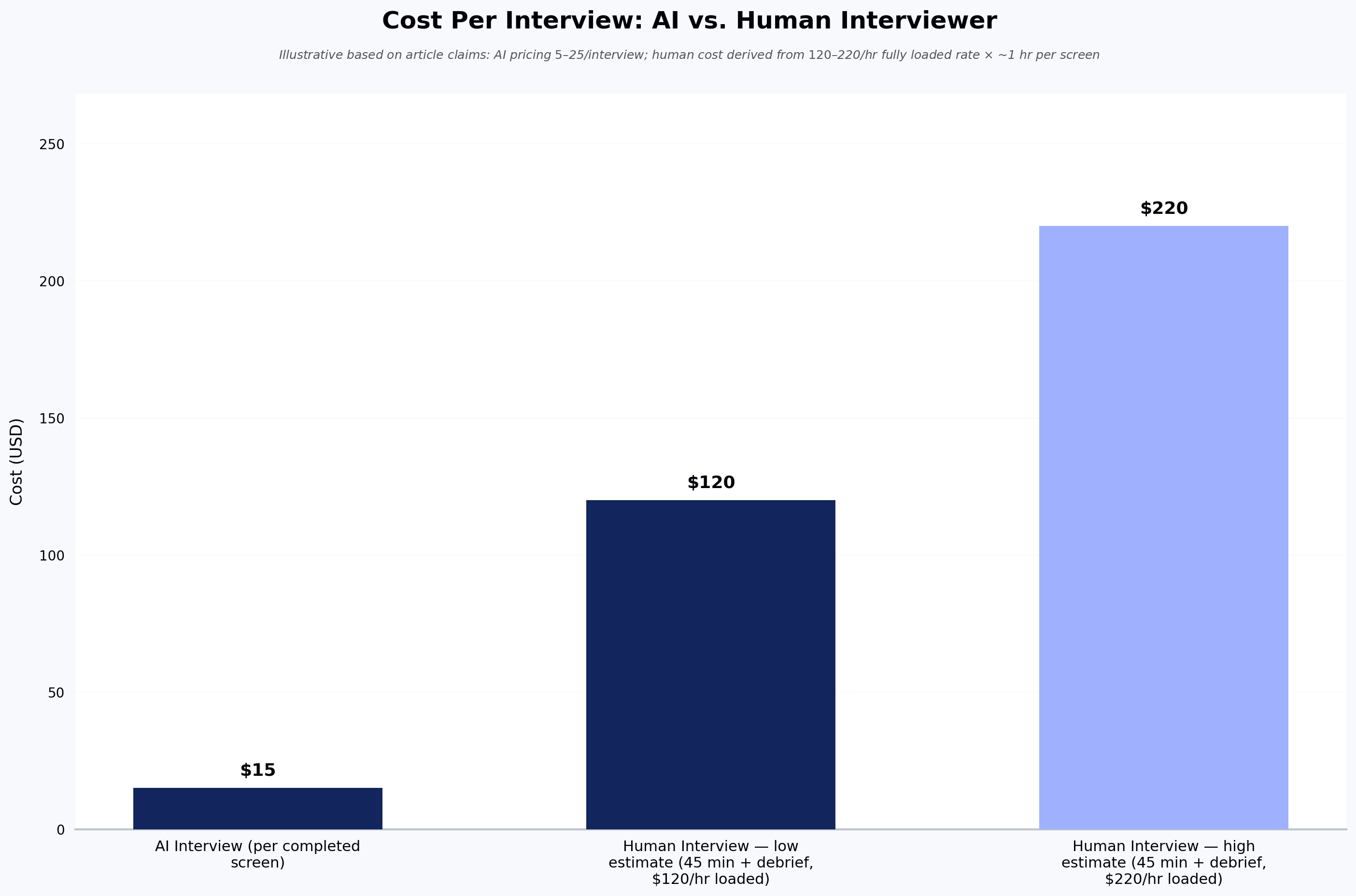
The cost comparison depends on what you count. A senior engineer's fully loaded hour — base compensation plus benefits, equity, and overhead — typically runs roughly $120–$220 at large or well-funded tech companies, based on public salary data (Glassdoor, Salary.com) with a standard 1.3–1.4× loading multiplier. In our experience with enterprise customers, the higher end of that range is closer to what FAANG-tier employers actually spend on interviewer time. A first-round technical screen takes 45–60 minutes plus 15 minutes of debrief. Multiply by every candidate who gets to first round, and the annual cost of human first-round screening at a company hiring 200 engineers a year runs into the mid-six figures — most of it engineer time, not recruiter time.
AI interview pricing varies by model: most commercial platforms (HireVue, Spark Hire, Willo) publish only subscription or seat-based pricing, while usage-based plans, where available, typically run $5–$25 per completed interview at non-enterprise tiers. Enterprise contracts are almost always custom-priced. That is roughly 5–10× cheaper per interview than the human alternative when you include senior engineer time, and more at the extremes of both ranges. The math flips only if you were previously screening candidates with junior recruiters and now want AI to replace what a senior engineer would have done anyway — a scope creep the AI vendors rarely correct.
Scalability is where the gap widens further. Modern AI interview platforms can run thousands of screening interviews in parallel over a single weekend — the kind of volume that is not achievable with human panels regardless of headcount.

Bias in AI interviewers is different from bias in humans — not necessarily less, but different. Human interviewers are biased by physical appearance, accent, shared background, time of day, and mood. AI interviewers are biased by training data, by the audio and video features the model was trained to weigh, and by the demographics of the population the model was validated on.
The honest framing is that AI produces more consistent evaluation across candidates — the same candidate answering the same way gets the same score — while human interviews produce more variable evaluation that averages out across many interviewers but hits individual candidates unpredictably. Neither is bias-free.
For BFSI and other regulated hiring contexts, the defensibility argument favors AI on record-keeping: every interview is recorded, every score has a rubric-linked justification, and the audit trail exists by default. For teams facing adverse-impact scrutiny, that trail is worth more than the marginal accuracy debate.
Benefits:
Limitations:
Benefits:
Limitations:
Use an AI interviewer for the first structured screening round when hiring volume exceeds what your team can handle without introducing scheduling delays. Specific triggers:
The AI interviewer earns its place at the top of the funnel, where the job is to filter reliably, not to charm.
Human interviewers are the right call for anything past the initial screen where judgment, negotiation, or mutual evaluation matters. Specifically:
Yes — and in teams running structured technical hiring at scale, they already do. The pattern that works: AI handles the first screen and the identity verification, humans handle the panel, the system design round, the hiring manager conversation, and the offer close. For a practical walk-through of this handoff, see how to use AI interview tools without losing human judgment.
This split does two things at once. It removes the highest-volume, lowest-judgment work from senior engineers, freeing them to spend interview time where their calibration actually matters. And it gives candidates a faster path through the funnel — a first-round result in 24 hours instead of 10 days.
For teams designing this loop, the structured interview design and rubric are the leverage points. A bad rubric applied consistently by AI produces bad hires at scale. A good rubric applied consistently produces the opposite. Invest in the rubric first, then pick the tools.
The choice is rarely all-or-nothing. To decide where to place each in your loop, ask four questions:
If you are running technical hiring at scale, the answer is almost always "both, in the right places." The teams that treat this as a binary spend the next 18 months rediscovering that they need the other half.
Should we disclose to candidates that the first-round interviewer is AI? Yes, and explicitly. Tell candidates the format is an AI-led structured screen, what will be evaluated (answers against a rubric, code correctness, reasoning), and what will not (tone scoring, "confidence" inference, appearance). Candidates who understand the format perform closer to their real level, and disclosure removes the main source of post-interview complaints — the suspicion of being scored on invisible criteria.
Is an AI interview a red flag? Not by itself. A company using AI for first-round screening is usually optimizing for candidate response time and interviewer consistency — both of which benefit candidates. The red flag is when AI is used past the screening stage without human involvement in later rounds. If you never speak to a human before an offer, the company has skipped the parts of the process that should be evaluating mutual fit. The fair concern candidates raise on forums like r/recruitinghell is that an all-AI pipeline with no human contact can signal low employer investment in the hire — which is why the AI-first-screen, humans-past-that split matters as much for candidate trust as for accuracy.
Are companies actually using AI interviewers? Yes, and increasingly at enterprise scale. In our experience working with enterprise customers, AI interview adoption accelerated sharply through 2024 and 2025 as AI-generated resumes made resume screening unreliable and volume made human screening unaffordable. The pattern is concentrated in high-volume technical hiring, campus recruiting, and BFSI compliance-driven contexts.
Does AI reduce hiring bias? It changes bias more than it reduces it. AI produces more consistent evaluation across candidates but can encode bias from training data. The defensible claim is that rubric-applied AI evaluation doesn't vary by interviewer mood or fatigue — not that it is bias-free. For teams optimizing for defensibility and audit trail, that consistency is worth real money.
Can AI interviewers assess soft skills? Partially. Communication clarity, structured reasoning, and question comprehension are all measurable from an AI interview transcript. Empathy, humor, cultural fit, and stakeholder navigation are not. Any vendor claiming full soft-skills evaluation from a 30-minute AI interview is overselling.
How can I tell if an interviewer is AI? A few reliable signals: the interview is launched from an emailed link rather than a calendar invite with a human's name; the interface shows an avatar or voice-only prompt with a fixed question sequence; the interviewer does not reference specifics from your resume beyond what you typed into the application; follow-ups are triggered by keywords in your answer rather than genuine curiosity; and you cannot ask the interviewer questions back and get a substantive reply. Most reputable employers now disclose the format upfront — if you are unsure, ask the recruiter directly.
If you are evaluating where AI interviewing fits in your loop, schedule a demo of HackerEarth OnScreen to see how structured AI interviews work alongside your existing panel process — and where the handoff between AI and human interviewers should sit for your role mix.
Offices
Sunnyvale · Bengaluru · Remote worldwide
