

Meta title: AI Interviewers vs. ATS Screening in Technical Hiring Meta description: AI interviewers apply a consistent rubric to every candidate, easing ATS screening load in technical hiring while keeping recruiter judgment central.
Estimated read time: 8 minutes
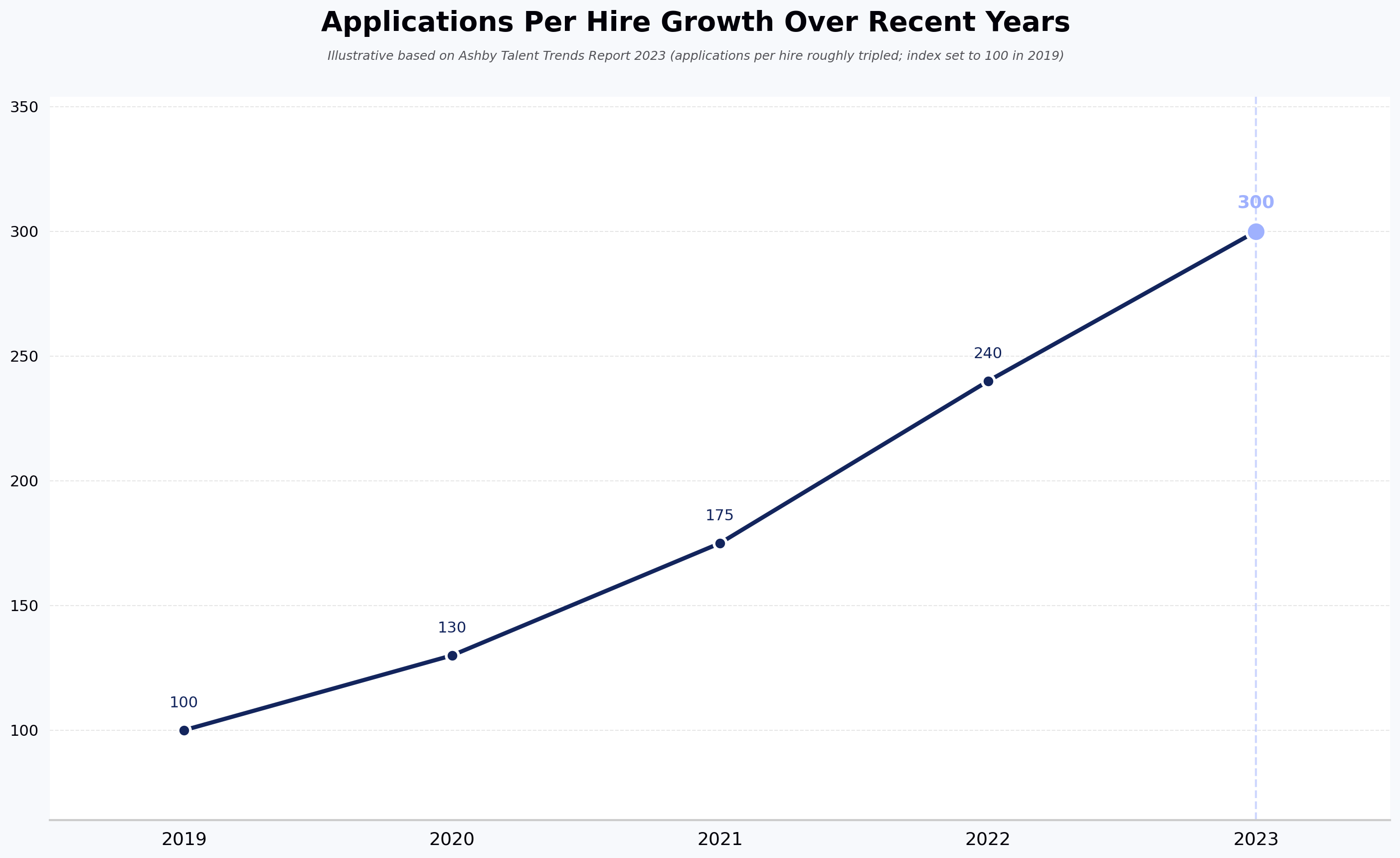
If you lead a technical hiring pipeline, your ATS is no longer the bottleneck you can ignore. Per the 2023 Ashby Talent Trends Report, applications per hire have roughly tripled, and keyword-matching ATS tools cannot keep pace with that volume. An AI interviewer — software that conducts structured, two-way candidate conversations using video-based AI interview avatars and applies a consistent rubric to every response — is increasingly used to supplement or replace ATS resume screening as the first filter in technical hiring. For recruiters and talent acquisition leaders, the practical question is which parts of screening to hand off to an AI interviewer and which to keep human.
Behind the tripling in applications sits a second trend that hits recruiter capacity harder: interviews per hire have also risen year-over-year, meaning each additional application does not just add screening work — it adds downstream interview work too. The Ashby report cited above also documents a significant rise in interviews per hire year-over-year; specific percentage changes vary by role and segment within the underlying dataset, but the trend line is consistent: recruiters spend more time filtering unqualified candidates than engaging promising ones.
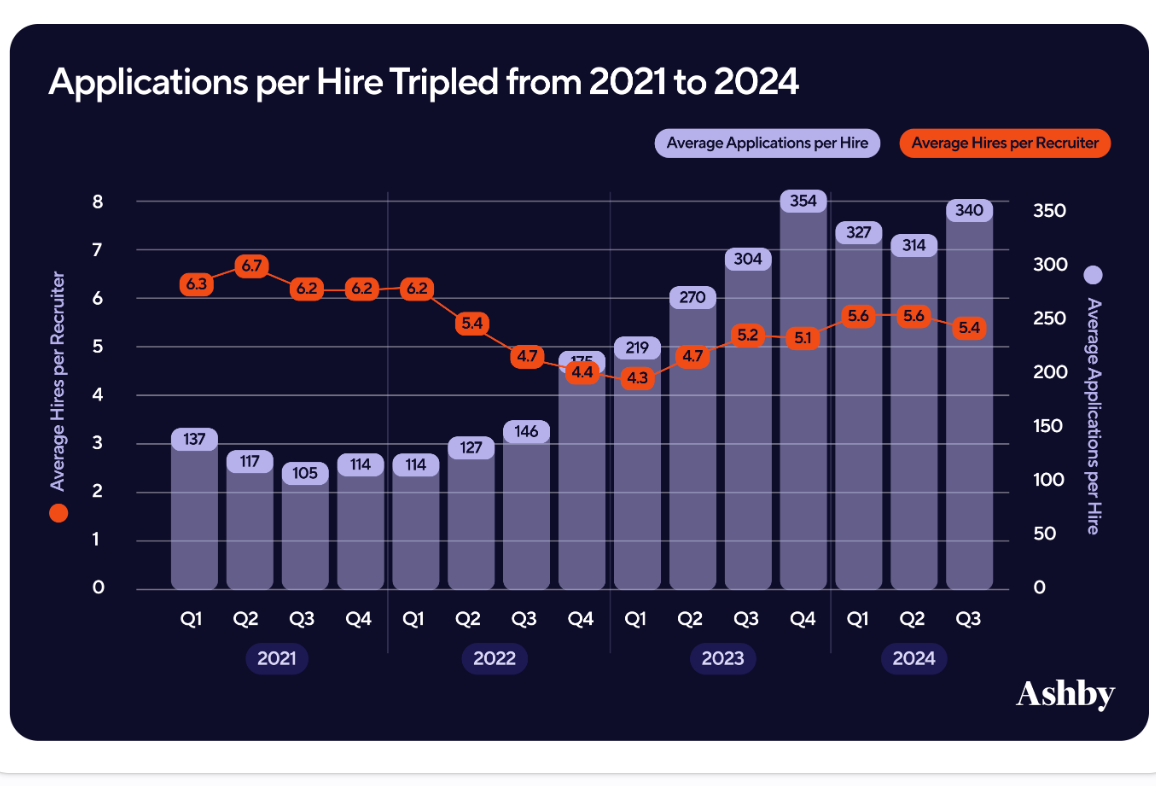
Credit - Ashby Talent Trends Report (2023)
For technical roles, the burden compounds. Hiring a developer or engineer typically requires more interview hours than a comparable non-technical role, though the exact gap varies by company, level, and source. Beyond direct spend, the cost shows up as delayed projects, engineer interview load, and a recruiting process that cannot scale.
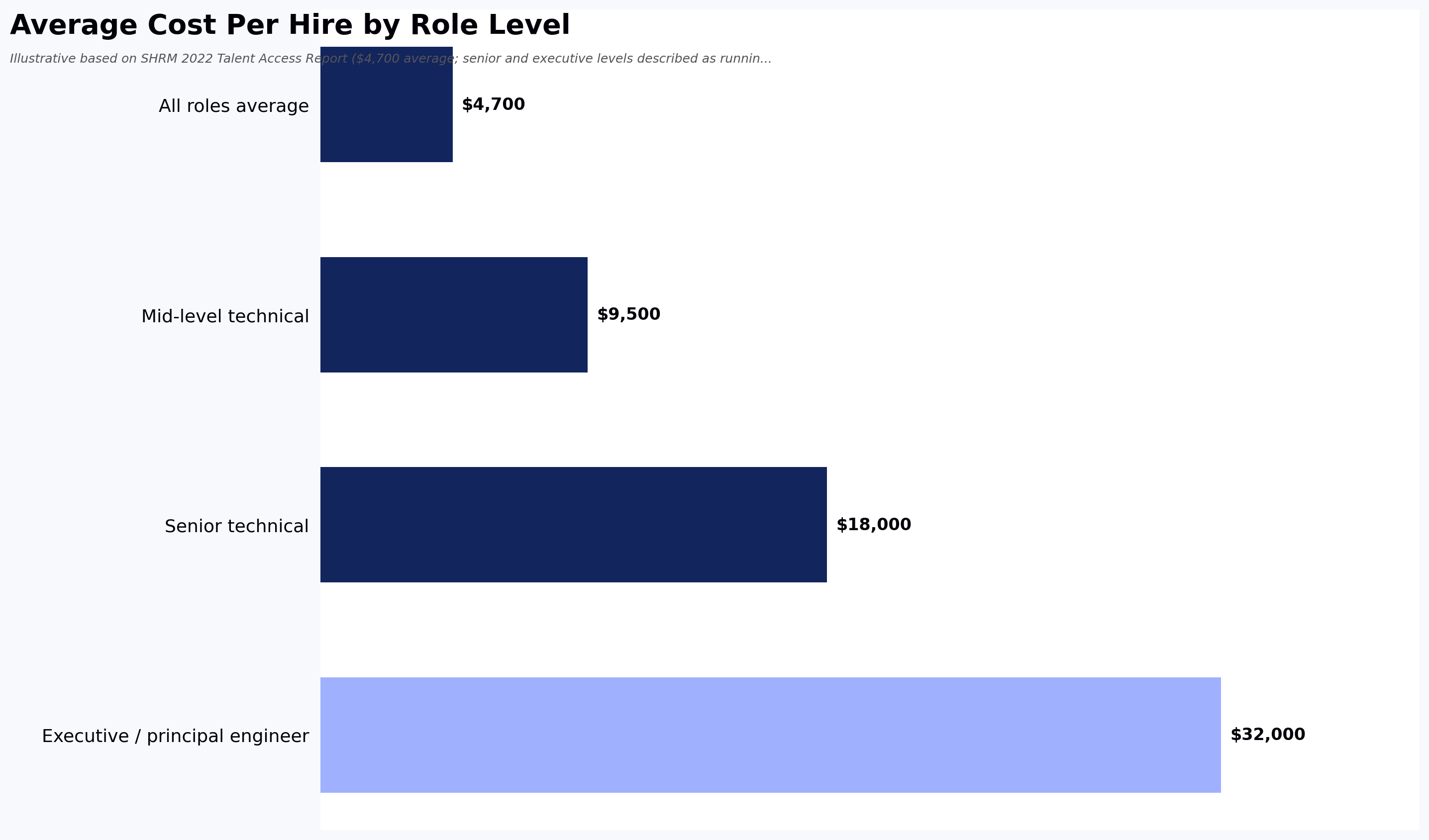
These delays translate directly into spend: SHRM's 2022 Human Capital Benchmarking Report puts the average cost per hire at roughly $4,700 (as of 2022 — more recent SHRM benchmarks trend higher), with senior and executive-level technical hires often running several times higher. For a recruiter running a technical pipeline, that published benchmark is likely a floor rather than a ceiling: recruiter overtime, engineering capacity consumed by interviews, and productivity loss on open roles all compound the figure in ways cross-industry averages do not capture.
Traditional ATS-led hiring carries deeper costs that rarely appear on spreadsheets — and most of them land directly on the recruiter's desk.
Recruitment capacity is the first casualty. When recruiters spend the majority of their week on administrative tasks and initial screenings — a pattern reported across recruiter productivity surveys, including Ashby's — they have little time for the work that builds their credibility with hiring managers: sourcing passive talent, calibrating on role requirements, and managing candidate relationships through to offer.
Inconsistent evaluation is the second. Different interviewers ask different questions, evaluate against different standards, and bring different energy levels depending on the day. One candidate may face a rigorous technical grilling while another moves through with surface-level questions. For a recruiter, this inconsistency erodes trust with the hiring manager — every debrief becomes a negotiation over whether the signal is real or an artifact of who ran the screen.
Human bias is a related vulnerability. Research summarized by SHRM finds that unstructured interviews are vulnerable to unconscious bias — affecting decisions based on candidates' names, educational backgrounds, or even interview time slots. These biases also create legal exposure under frameworks such as NYC Local Law 144, EEOC guidance on algorithmic hiring tools, and the EU AI Act's high-risk classification for hiring systems. For a broader view of where AI helps and where it introduces risk, see AI In Recruitment: The Good, The Bad, The Ugly.
Candidate experience is the final cost. Per CareerPlug's 2024 Candidate Experience Report, 26% of job seekers have declined a job offer because of poor communication or unclear job expectations during the hiring process. Long screening delays and disorganized early-stage interviews compound this — candidates who wait weeks after applying, or receive no feedback after a first-round screen, share those experiences publicly and erode employer brand at the top of the funnel.
High-performing technical hiring teams share three operational traits: objective evaluation, consistent methodology, and efficient throughput. Each can be tied to a specific recruiter workflow change.
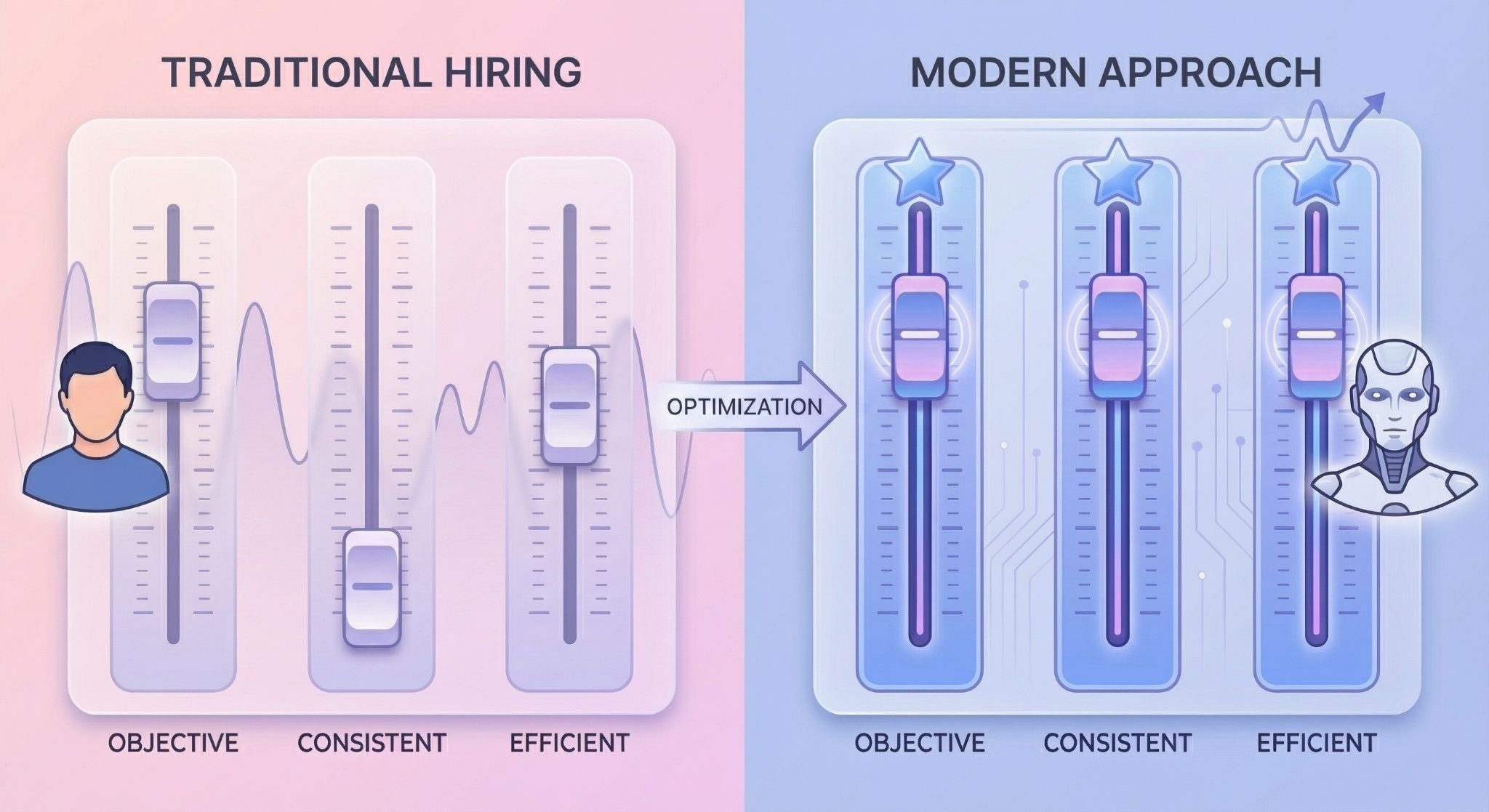
The three pillars of modern talent acquisition
Objective screening means every candidate is scored against the same rubric, independent of the interviewer's mood or the candidate's name. Specifically: define a rubric tied to the role's competencies, score against that rubric, and require evaluators to cite evidence from the response. Companies that adopt rubric-based screening report more comparable data across candidates and reduced reliance on gut-feel decisions.
Consistent methodology applies the same questions, rubric, and scoring pass to every candidate, whether they apply at 9 AM Monday or 11 PM Friday. Over time, that consistency produces benchmarkable data recruiters can use to refine criteria against actual hire outcomes.
Efficient processes let a team screen hundreds of candidates without proportionally adding recruiters or engineering interview load. In practice, recruiters delegate first-round structured screens to an AI interviewer and reserve their own time for offer conversations, calibration, and pipeline strategy.
Large enterprises historically built this through standardized interview training, structured scorecards, and dedicated recruiting operations teams. AI interviewer tooling now extends a similar standard to teams with sufficient candidate volume to justify structured first-round automation — typically role families with more than a handful of candidates per cycle.
An AI interviewer addresses volume directly: structured first-round conversations run in parallel, on candidate time, with scorecards delivered to recruiters rather than added to their calendars. Reported time-to-fill improvements vary widely by organization, role, and integration approach, and should be validated with a pilot rather than assumed from vendor benchmarks. For a wider look at the tooling landscape, see this 2025 guide to AI hiring tools for tech recruiting.
The bias-reduction case is more nuanced than vendor marketing suggests. Structured, rubric-driven evaluation is more consistent across candidates than human-led screens, because the same questions and scoring criteria apply to everyone. That consistency reduces some forms of interviewer variability, but AI systems can also encode bias from their training data, which is why frameworks such as NYC Local Law 144 require bias audits of automated employment decision tools.
For recruiters, an AI interviewer shifts the role from administrative coordinator to talent advisor. Instead of running repetitive first-round screens, recruiters can spend that time on candidate engagement, offer negotiation, and pipeline development. Practically, this means recruiters can review structured scorecards and recordings rather than conducting every introductory call themselves. For more on how AI is reshaping the broader funnel, see How AI Is Transforming The Talent Acquisition Process In Tech?.
AI interviewers are not the right fit for every role or context. Senior leadership hires, highly creative positions, and roles where cultural judgment is the primary signal still benefit from human-led conversations. Candidates with low-bandwidth internet connections, older hardware, or accessibility needs can be disadvantaged by video-based AI assessment, which is a reason to offer alternative formats. Jurisdictions including New York City and several U.S. states require bias audits and candidate notification for automated hiring tools; the EU AI Act classifies hiring systems as high-risk and imposes additional transparency obligations. Any AI interviewer deployment should account for these limits rather than treat the tool as universal.
The pattern above — structured, rubric-scored, parallel first-round screens — is what a well-designed AI interviewer product should operationalize. HackerEarth's implementation is one example of how the pieces fit together.
For recruiters, the two failure modes of first-round screens are inconsistent evaluation across interviewers and no reliable way to confirm the candidate on the call is the candidate being evaluated. HackerEarth, a skills intelligence platform used by enterprise technical hiring teams, offers two products that together address these failure modes: OnScreen, an always-on AI interview platform using video-based AI interview avatars for role-calibrated conversations, addresses the first by applying the same rubric to every candidate, and the second through identity verification tied to the interview session; Skill Assessments covers coding evaluation separately, with role-mapped questions across a range of programming languages. This is particularly relevant given how AI-generated CVs are breaking technical hiring at the resume layer. Buyers should confirm evaluation-model, training-data, and audit specifics with HackerEarth directly.
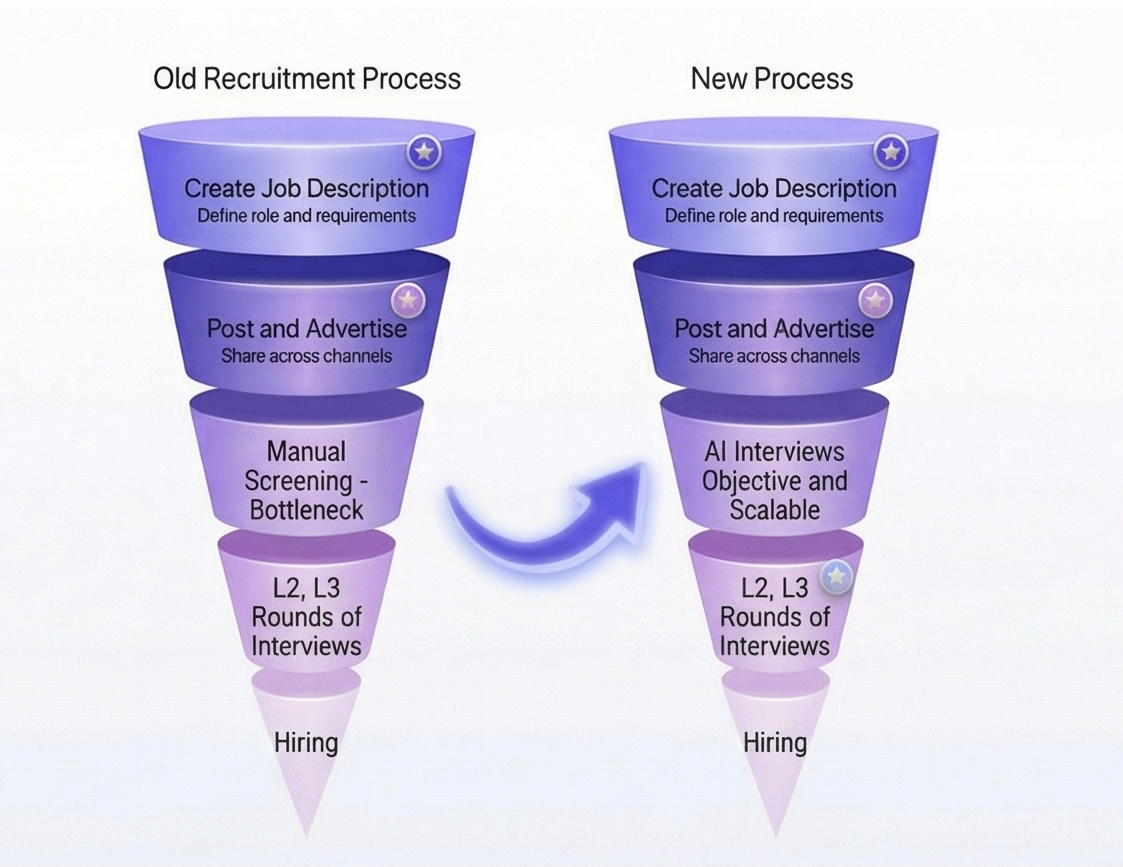
If you are evaluating a first-round screening change, a practical starting point is to pilot a structured AI interviewer alongside your current process for 60–90 days on a single role family, then compare scorecard data to hire outcomes before broader rollout.
See it in your workflow: Request an OnScreen demo to walk through the structured interview flow, identity verification, and scorecard review on a role of your choice.
What is an AI interviewer — and what is it not? An AI interviewer is software that conducts structured, rubric-scored candidate conversations automatically, without a human interviewer present. It is a first-round structured screen, not a hiring decision-maker, and not a replacement for hiring-manager judgment on scope, level, or team fit. The definition breaks down in practice when teams use AI interview scores as a sole pass/fail gate rather than one signal in a scorecard reviewed by a recruiter and hiring manager.
Does AI interviewing reduce bias? AI interviewing can reduce some forms of interviewer variability because the same questions and rubric apply to every candidate. It does not eliminate bias: AI systems can encode bias from training data, which is why jurisdictions such as New York City require bias audits of automated employment decision tools under Local Law 144.
How does an AI interview agent work? The counterintuitive part: the score is only as good as the rubric — a poorly defined rubric produces confident but meaningless scores. Under the hood, the agent scores each rubric dimension independently before aggregating, so rubric design (not model choice) is where teams should spend their calibration effort.
Does replacing ATS resume screening mean removing resume review entirely? The tradeoff is sequencing, not elimination. Moving skills demonstration earlier via an AI interview means resumes get reviewed later in the funnel, on a smaller pool — which flips the traditional funnel economics but can create friction with hiring managers who want to see resumes first. Teams that shift sequencing successfully usually pair it with a hiring-manager calibration session to align on which credentials still gate an offer versus which are informational.
Are AI interviewers legal to use in hiring? In most jurisdictions, yes, with conditions. NYC Local Law 144 requires bias audits and candidate notification. The EU AI Act classifies hiring AI as high-risk and imposes transparency requirements. EEOC guidance applies to algorithmic hiring tools in the U.S. Confirm requirements in each jurisdiction where you hire.
Does ATS resume screening reject AI-generated resumes? Most ATS platforms do not specifically detect or reject AI-generated resumes — they parse keywords and structured fields regardless of authorship. That is part of why skills-based first-round screening via an AI interviewer is gaining traction: it evaluates demonstrated ability rather than resume text that may have been drafted or embellished by a generative tool.
When should you not use an AI interviewer? Senior leadership roles, highly creative positions, and contexts where candidate accessibility or connectivity is a concern are usually better served by human-led or hybrid formats.
I wanted to understand what separates working code from good code. So I used VibeCodeArena.ai to pick a problem statement where different LLMs produce code for the same prompt. Upon landing on the main page of VibeCodeArena, I could see different challenges. Since I was interested in an Image carousal application, I picked the challenge with the prompt "Make a simple image carousel that lets users click 'next' and 'previous' buttons to cycle through images."
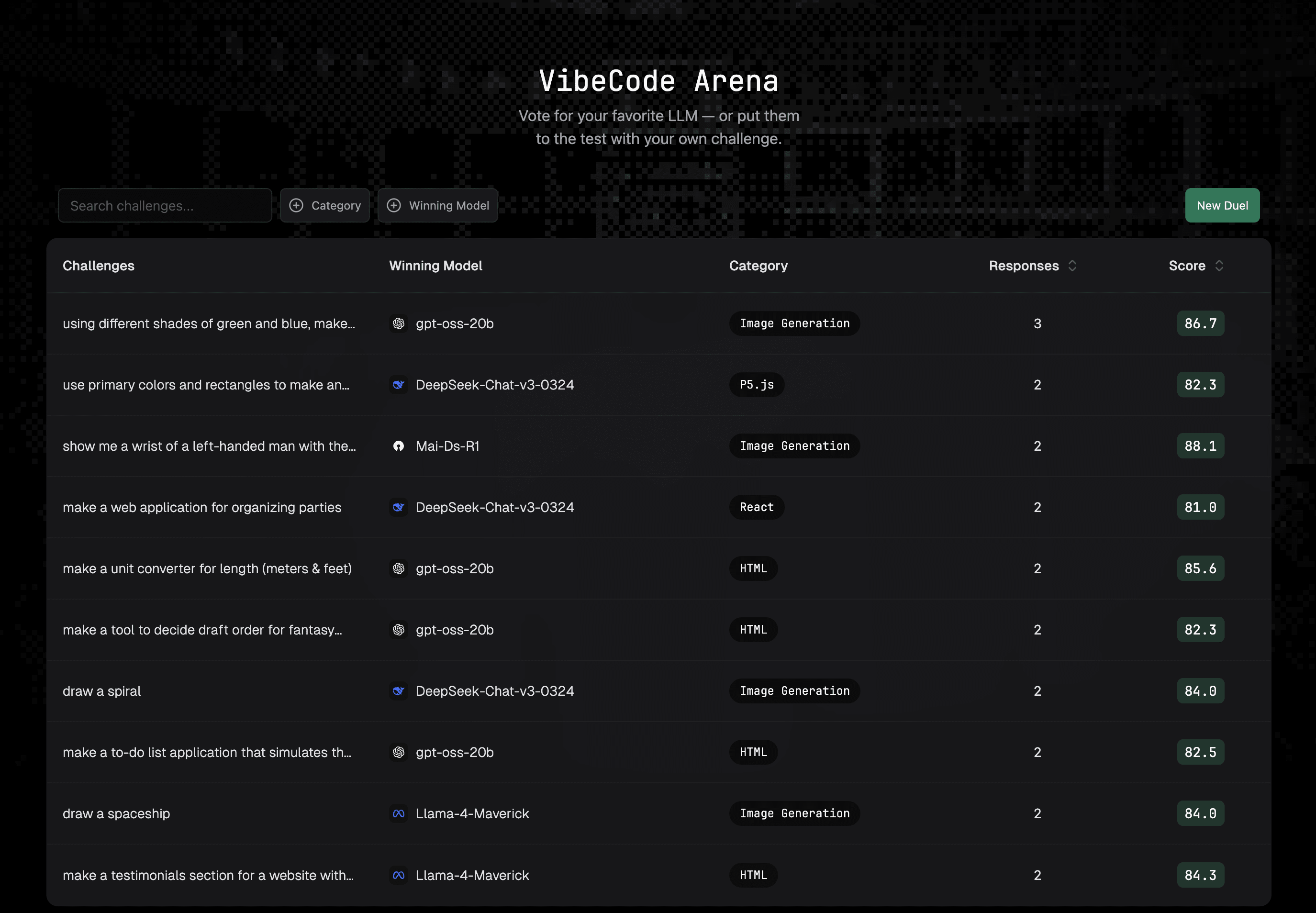
Within seconds, I had code from multiple LLMs, including DeepSeek, Mistral, GPT, and Llama. Each code sample also had an objective evaluation score. I was pleasantly surprised to see so many solutions for the same problem. I picked gpt-oss-20b model from OpenAI. For this experiment, I wanted to focus on learning how to code better so either one of the LLMs could have worked. But VibeCodeArena can also be used to evaluate different LLMs to help make a decision about which model to use for what problem statement.

The model had produced a clean HTML, CSS, and JavaScript. The code looked professional. I could see the preview of the code by clicking on the render icon. It worked perfectly in my browser. The carousel was smooth, and the images loaded beautifully.

But was it actually good code?
I had no idea. That's when I decided to look at the evaluation metrics
A working image carousel with:
It looked like something a senior developer would write. But I had questions:
Was it secure? Was it optimized? Would it scale? Were there better ways to structure it?
Without objective evaluation, I had no answers. So, I proceeded to look at the detailed evaluation metrics for this code
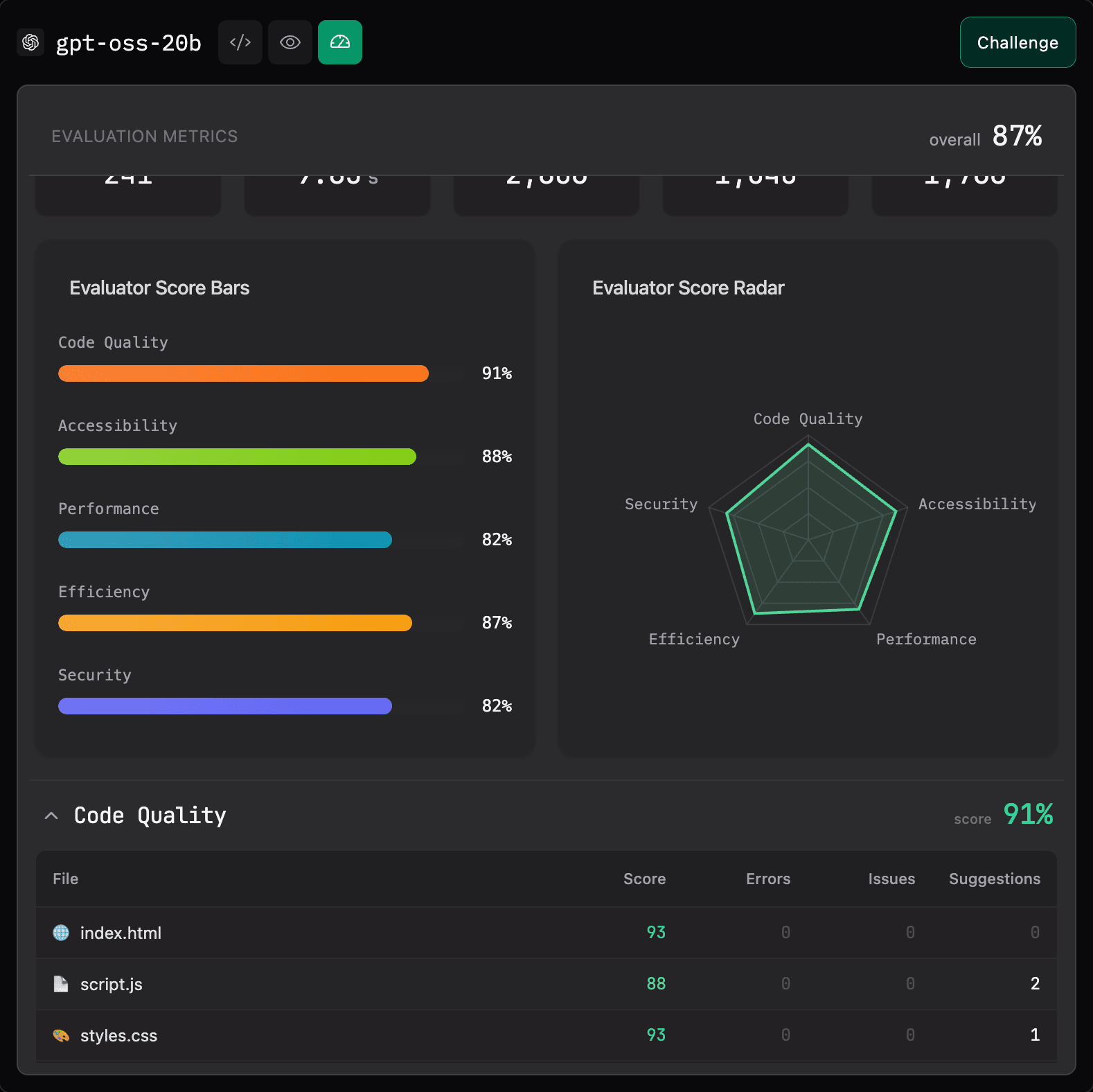
The platform's objective evaluation revealed issues I never would have spotted:
No Content Security Policy (CSP): My carousel was wide open to XSS attacks. Anyone could inject malicious scripts through the image URLs or manipulate the DOM. VibeCodeArena flagged this immediately and recommended implementing CSP headers.
Missing Input Validation: The platform pointed out that while the code handles image errors, it doesn't validate or sanitize the image sources. A malicious actor could potentially exploit this.
Hardcoded Configuration: Image URLs and settings were hardcoded directly in the code. The platform recommended using environment variables instead - a best practice I completely overlooked.
SQL Injection Vulnerability Patterns: Even though this carousel doesn't use a database, the platform flagged coding patterns that could lead to SQL injection in similar contexts. This kind of forward-thinking analysis helps prevent copy-paste security disasters.
DOM Structure Depth (15 levels): VibeCodeArena measured my DOM at 15 levels deep. I had no idea. This creates unnecessary rendering overhead that would get worse as the carousel scales.
Expensive DOM Queries: The JavaScript was repeatedly querying the DOM without caching results. Under load, this would create performance bottlenecks I'd never notice in local testing.
Missing Performance Optimizations: The platform provided a checklist of optimizations I didn't even know existed:
Each of these seems minor, but together they compound into a poor user experience.
High Nesting Depth (4 levels): My JavaScript had logic nested 4 levels deep. VibeCodeArena flagged this as a maintainability concern and suggested flattening the logic.
Overly Specific CSS Selectors (depth: 9): My CSS had selectors 9 levels deep, making it brittle and hard to refactor. I thought I was being thorough; I was actually creating maintenance nightmares.
Code Duplication (7.9%): The platform detected nearly 8% code duplication across files. That's technical debt accumulating from day one.
Moderate Maintainability Index (67.5): While not terrible, the platform showed there's significant room for improvement in code maintainability.
The platform also flagged missing elements that separate hobby projects from professional code:
Here's what hit me: I had no framework for evaluating code quality beyond "does it work?"
The carousel functioned. It was accessible. It had error handling. But I couldn't tell you if it was secure, optimized, or maintainable.
VibeCodeArena gave me that framework. It didn't just point out problems, it taught me what production-ready code looks like.
This is when I discovered the real power of the platform. Here's my process now:
I start with a prompt and let the AI generate the initial solution. This gives me a working baseline.
I can get comprehensive analysis across:
This is where I learn. Each issue includes explanation of why it matters and how to fix it.
Here's the game-changer: I click the "Challenge" button and start fixing the issues based on the suggestions. This turns passive reading into active learning.
Do I implement CSP headers correctly? Does flattening the nested logic actually improve readability? What happens when I add dns-prefetch hints?
I can even use AI to help improve my code. For this action, I can use from a list of several available models that don't need to be the same one that generated the code. This helps me to explore which models are good at what kind of tasks.
For my experiment, I decided to work on two suggestions provided by VibeCodeArena by preloading critical CSS/JS resources with <link rel="preload"> for faster rendering in index.html and by adding explicit width and height attributes to images to prevent layout shift in index.html. The code editor gave me change summary before I submitted by code for evaluation.
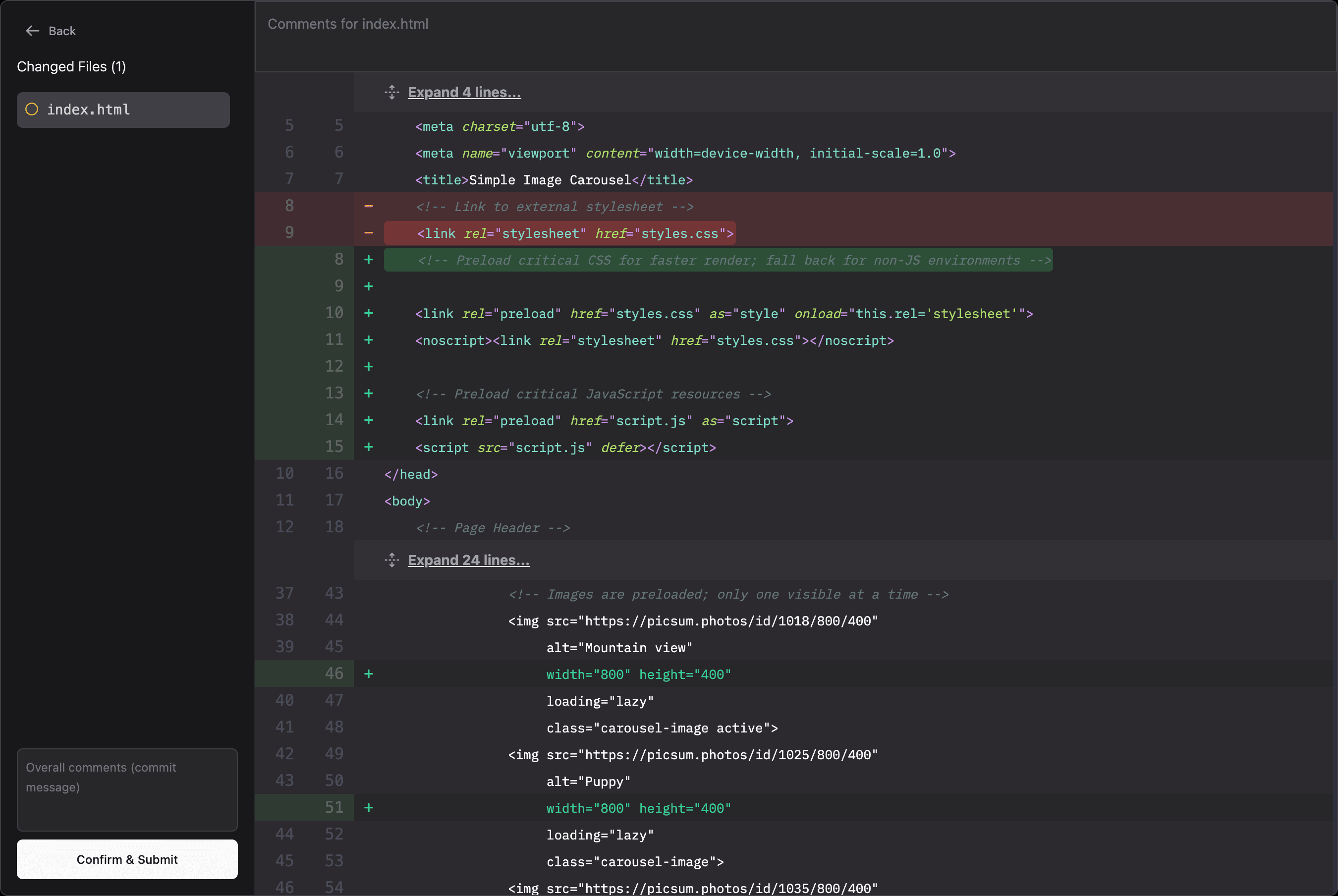
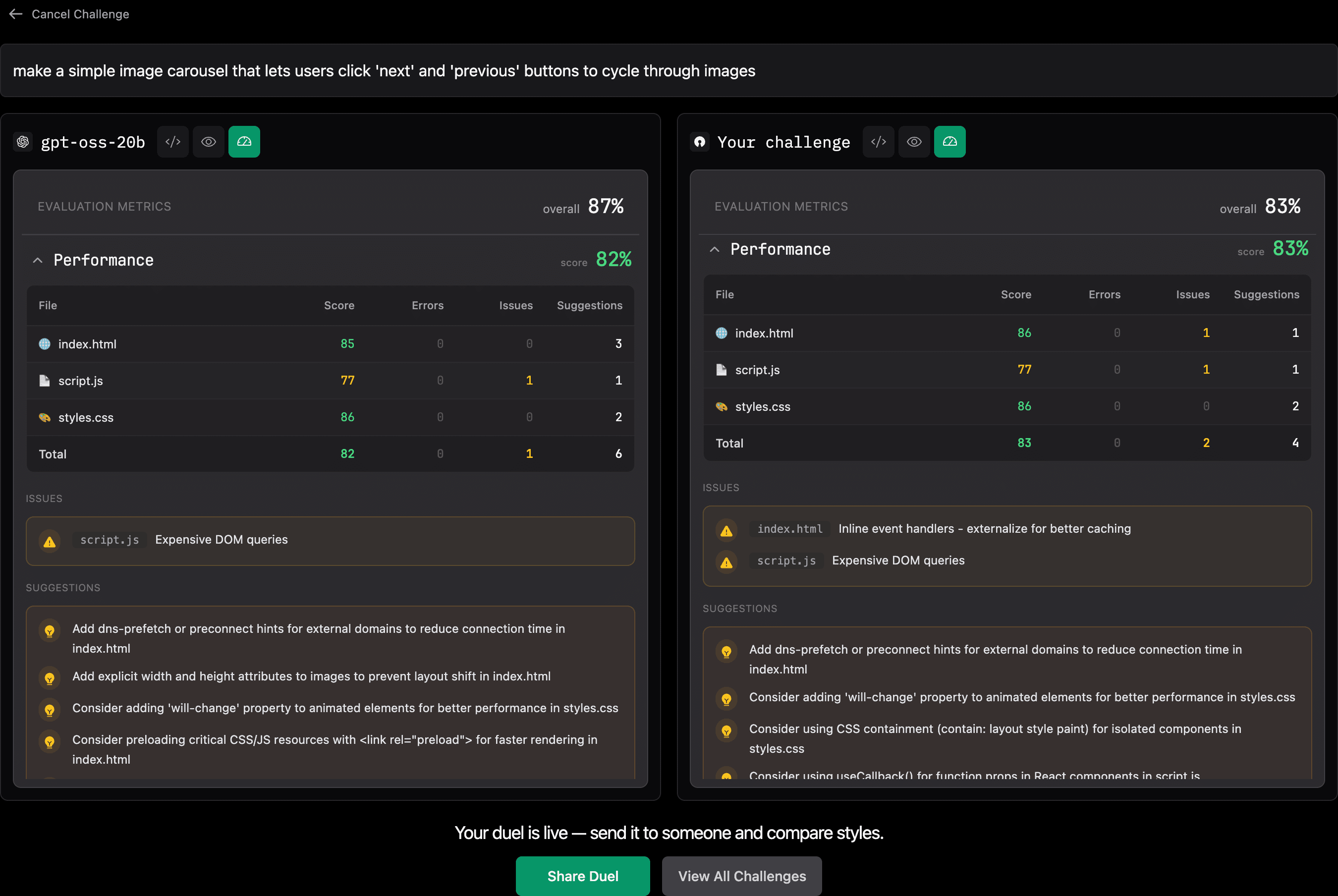
After making improvements, I submit my code for evaluation. Now I see:
My changes helped improve the performance metric of this simple code from 82% to 83% - Yay! But this was just one small change. I now believe that by acting upon multiple suggestions, I can easily improve the quality of the code that I write versus just relying on prompts.
Each improvement can move me up the leaderboard. I'm not just learning in isolation—I'm seeing how my solutions compare to other developers and AI models.
So, this is the loop: Generate → Analyze → Challenge → Improve → Measure → Repeat.
Every iteration makes me better at both evaluating AI code and writing better prompts.
This experience taught me three critical lessons:
AI models are incredible at generating code that functions. But "it works" tells you nothing about security, performance, or maintainability.
The gap between "functional" and "production-ready" is where real learning happens. VibeCodeArena makes that gap visible and teachable.
I used to iterate on code blindly: "This seems better... I think?"
Now I know exactly what improved. When I flatten nested logic, I see the maintainability index go up. When I add CSP headers, I see security scores improve. When I optimize selectors, I see performance gains.
Measurement transforms vague improvement into concrete progress.
The leaderboard changed everything for me. I'm not just trying to write "good enough" code—I'm trying to climb past other developers and even beat the AI models.
This competitive element keeps me pushing to learn one more optimization, fix one more issue, implement one more best practice.
VibeCodeArena isn't just an evaluation tool—it's a structured learning environment. Here's what makes it effective:
Immediate Feedback: I see issues the moment I submit code, not weeks later in code review.
Contextual Education: Each issue comes with explanation and guidance. I learn why something matters, not just that it's wrong.
Iterative Improvement: The "Challenge" button transforms evaluation into action. I learn by doing, not just reading.
Measurable Progress: I can track my improvement over time—both in code quality scores and leaderboard position.
Comparative Learning: Seeing how my solutions stack up against others shows me what's possible and motivates me to reach higher.
Through this iterative process, I've gained practical knowledge I never would have developed just reading documentation:
Each "Challenge" cycle teaches me something new. And because I'm measuring the impact, I know what actually works.
AI coding tools are incredible for generating starting points. But they don't produce high quality code and can't teach you what good code looks like or how to improve it.
VibeCodeArena bridges that gap by providing:
✓ Objective analysis that shows you what's actually wrong
✓ Educational feedback that explains why it matters
✓ A "Challenge" system that turns learning into action
✓ Measurable improvement tracking so you know what works
✓ Competitive motivation through leaderboards
My "simple image carousel" taught me an important lesson: The real skill isn't generating code with AI. It's knowing how to evaluate it, improve it, and learn from the process.
The future of AI-assisted development isn't just about prompting better. It's about developing the judgment to make AI-generated code production-ready. That requires structured learning, objective feedback, and iterative improvement. And that's exactly what VibeCodeArena delivers.
Here is a link to the code for the image carousal I used for my learning journey
#AIcoding #WebDevelopment #CodeQuality #VibeCoding #SoftwareEngineering #LearningToCode

Vibe coding — describing software in plain English and letting an AI model write the code — has moved from a Twitter provocation to a working method inside serious engineering teams in under a year. That is unusual. Most "future of development" ideas take a decade to matter. This one is already in your codebase, whether or not you sanctioned it.
The scale of adoption is what makes this urgent. According to GitHub's Octoverse 2024 report, AI-assisted contributions have spread across a growing share of active repositories on the platform, and reports from Google and Microsoft leadership have put AI-generated code at roughly 25–30% or more of new code in some production settings. The exact share depends on how you count, but the trend is not in dispute. The question for engineering leaders, recruiters, and L&D heads is no longer whether vibe coding matters. It is what to do about the hiring rubric, the review process, and the skills evaluation that were designed for a world where developers wrote every line themselves.
This guide covers what vibe coding is, how the workflow actually runs in production settings, the current tool landscape, and — most importantly for hiring teams — what changes about evaluating engineering talent when the code is half-written before the developer types.

Vibe coding is an AI-assisted development approach where a developer describes intent in natural language and an AI model generates the implementation. The developer's job shifts from writing syntax to specifying behavior, reviewing output, and correcting course through follow-up prompts.
Andrej Karpathy — a founding member of OpenAI, former Director of AI at Tesla, and founder of Eureka Labs — coined the term in a February 2025 post on X. He described a workflow where he would "fully give in to the vibes, embrace exponentials, and forget that the code even exists." He would describe what he wanted, accept most suggestions, and only intervene when something broke.
The name stuck faster than anyone expected. Collins Dictionary reportedly shortlisted "vibe coding" for its 2025 word-of-the-year list. Engineering blogs at companies including Anthropic have since published internal guidelines on when to use it and when not to, with similar discussions reported at other major engineering organizations.
The shift is not that developers stop thinking. It is that the thinking happens at a different altitude.
| Aspect | Traditional coding | Vibe coding |
|---|---|---|
| Input | Code written in a language | Natural language describing intent |
| Core skill | Syntax fluency, language mastery | Prompt clarity, architectural reasoning |
| Debugging | Line-by-line review | Iterative prompting plus targeted manual fixes |
| Speed | Methodical | Rapid generation, slower validation |
| Best fit | Complex, long-lived production systems | Prototypes, MVPs, internal tools, well-scoped features |
The important thing this table hides: vibe coding does not remove the need for programming knowledge. It relocates it. You need to know enough to spot when the AI is wrong — and current models are wrong often enough that "trust and ship" is not a defensible practice for anything past a prototype.
The process starts with a prompt that describes the desired behavior, the constraints, and the context. A weak prompt produces weak code. A strong prompt reads more like a small design document than a chat message.
Weak: "Write me a login form."
Strong: "Write a React login form component using our existing useAuth hook. It should validate email format client-side, disable the submit button while the request is in flight, and show a specific error message for 401 versus 500 responses. Match the styling of the SignupForm component in the same directory."
The second prompt gets code you can actually merge. The first gets code you have to rewrite.
One-shot generation almost never produces production code. The real workflow is a conversation: the developer submits a prompt, reads the output, identifies gaps, and prompts again. "Add input validation for the email field and return 422 for malformed requests." "Refactor to use our error-handling middleware." "Add tests covering the empty-payload case."
Senior engineers converge faster because they know what to ask for. Junior engineers often accept the first plausible-looking output — which is where most vibe-coding accidents happen.
AI-generated code needs the same review discipline as code from a new hire. Unit tests, edge cases, security review, and architectural fit — none of that goes away. If anything, review matters more, because AI produces code that compiles and passes surface tests while hiding subtle bugs: off-by-one errors, missing null checks, race conditions, insecure defaults.
Teams that handle vibe coding well treat AI output as a pull request from a fast but inexperienced contributor — reviewed with skepticism, tested against the edge cases, and rejected when it doesn't fit. Where things go wrong is when AI output is treated as gospel and merged without scrutiny.
The vibe coding tool market has consolidated faster than most expected. As of late 2025, four categories matter.
This category barely existed a year ago. Teams now need places where developers can practice AI-assisted coding under realistic conditions and where hiring teams can evaluate that skill against a defined rubric — something none of the IDE or app-builder tools were designed to do. HackerEarth's VibeCode Arena fits here, providing rubric-based scoring across people, projects, and models so hiring and L&D teams can compare AI-collaboration performance rather than infer it.
Prototyping and MVPs. The clearest win. Building a working prototype in an afternoon that would have taken a week is increasingly common for well-scoped problems. Product managers can validate ideas before consuming engineering cycles. Founders can show working software to investors instead of Figma files.
Internal tools. Admin dashboards, one-off data processing scripts, migration tools — the code that gets written once, used for a specific purpose, and rarely revisited. Vibe coding is well-suited to this.
Boilerplate and scaffolding. CRUD endpoints, standard React components, test setup, configuration files. The mental energy senior engineers used to spend on this can go to design and architecture.
Learning. A developer new to a language or framework can ship working code while learning. The risk — and it is real — is that they don't learn what the AI is doing for them.
Security-sensitive code. AI models produce code with hardcoded credentials, SQL injection risks, missing input validation, and permissive defaults more often than most developers realize. A widely cited NYU study by Hammond Pearce and colleagues evaluating GitHub Copilot output found that roughly 40% of generated programs in security-relevant scenarios contained vulnerabilities. The models have improved since, but the class of problem has not gone away.
Complex systems with existing patterns. AI struggles to match a codebase's conventions, use its custom abstractions correctly, or reason about system-wide implications of a change. It will happily reinvent a utility function you already have.
Long-term maintenance. Code that works today but is poorly abstracted, inconsistently styled, or missing documentation creates real debt. Teams that let AI generate everything without review discipline end up with codebases that are difficult to extend and painful to debug six months later.
Performance-critical code. AI tends to produce functional code, not optimized code. If you care about the difference, you still need engineers who do.
This is where the discussion gets uncomfortable. Most technical hiring processes were designed to evaluate a candidate's ability to write code from scratch. That is not what most engineers spend their time on anymore.
If half of your team's new code is AI-generated, then the skill that matters most is not "can this candidate write a binary search from memory." It is:
None of these are new skills. All of them are now the primary skills. Traditional whiteboard interviews test almost none of them well. For a deeper treatment, see our guide to technical assessment strategy for modern engineering hiring.
The hiring teams doing this well are updating their evaluations in three ways.
Code review as a first-class evaluation. Give the candidate an AI-generated implementation of a feature and ask them to review it. Score them on what they catch — security issues, edge cases, architectural mismatches, missing tests. This is a better signal for a senior hire than any live coding exercise.
System design at earlier stages. Move design conversations earlier in the loop. Candidates who thrive in vibe-coding environments think in systems; those who struggle can produce code but can't explain the choices behind it.
AI-assisted problem solving under observation. Watch the candidate solve a problem with AI tools available. Do they prompt clearly? Do they verify the output? Do they know when to override the AI? This is a fundamentally different signal from a from-scratch coding round.
HackerEarth's Skill Assessments library supports rubric-based scoring across 1,000+ skills and 40+ languages, which hiring teams can configure to evaluate code review and AI-assisted problem solving alongside traditional coding rounds. FaceCode provides a live technical interview environment with an integrated code editor and panel support, so interviewers can observe candidate reasoning in real time, not just the final output.
In our experience working with hiring teams at HackerEarth over the past year, most stalled skills-based hiring rollouts have failed on the rubric, not the tool. Teams add AI-assisted evaluation to their process, don't agree on what "good" looks like, and end up with panels arguing about whether a candidate's use of Copilot counted as cheating or as competence. Decide before you interview. Write down what you want to see. Calibrate with two reviewers on the same submission before you use the rubric at scale. Our skills-based hiring guide covers rubric design in more detail.
Three skill areas are becoming the differentiators for engineers in a vibe-coding world.
Prompt engineering — specifically for code. Not the vague "prompt engineering" of 2023. The specific ability to write prompts that produce code matching a codebase's patterns, that include the right context, and that specify constraints clearly enough to get useful output on the first or second try.
Architecture-first thinking. Deciding what to build before generating how to build it. The AI is bad at architecture and good at implementation. Engineers who lead with design and use AI for execution outperform engineers who prompt and hope.
Code review at speed. The volume of code an engineer needs to review has gone up. Reading code fast, spotting problems, and knowing what to ignore are now core productivity skills.
For L&D teams, this reshapes the AI-fluency program conversation. "Teach everyone to use ChatGPT" is not a program. Programs that measure specific capability gains — through practice environments, rubric-based evaluation, and skill validation over course completion — are what shift actual on-the-job behavior. HackerEarth's SkillsGraph is designed to identify the specific AI-readiness gaps in an existing workforce, making AI-fluency legible as a workforce metric rather than an intuition.
Two developments will matter more than the rest over the next 18 months.
Agentic workflows will get more capable, then hit a wall. Tools like Claude Code and Cursor's Composer already handle multi-step tasks. Expect this to extend to "implement this feature end-to-end" for well-scoped problems within a year. In our assessment, based on current capability trajectories, tasks like "make our billing system multi-tenant" will remain out of reach for at least three more years, because the reasoning required is not just longer, it is qualitatively different.
Enterprise adoption will bifurcate. Companies that build good review discipline, evaluation rubrics, and AI-collaboration programs will get real productivity gains. Companies that treat AI as a magic productivity button will accumulate technical debt faster than they realize and blame the tool when the codebase becomes unmaintainable. Expect the gap between these two groups to become visible by 2027.
Vibe coding does not eliminate the need for skilled engineers. It changes what "skilled" means. Success in this environment depends on combining AI leverage with the judgment to know when the AI is wrong — and building organizations that hire and develop for both halves together, not either one alone.
If your hiring process still evaluates candidates primarily on from-scratch code writing, you are testing for a skill that is becoming a smaller part of the job. Two concrete moves for the next quarter:
See how HackerEarth evaluates AI-assisted engineering skills — including live code review, AI-collaboration scoring, and rubric-based evaluation designed for how software actually gets built now.
For prototypes and internal tools, yes with normal review. For production code in security-sensitive or high-reliability systems, only with the same review rigor you would apply to a new engineer's pull request — and often more, because AI output can look correct while hiding subtle failures. The teams shipping AI-generated code to production successfully treat every generation as untrusted until reviewed and tested.
Most engineering teams have moved past this debate. If your engineers use AI daily on the job, banning it during interviews tests a skill they will never use again. The better question is what you evaluate: pure recall (ban AI), or actual working ability (allow AI and score the reasoning). If you allow it, watch how the candidate uses it — that is where the signal is.
Probably not, but it will change what juniors do. The traditional path — write boilerplate, get feedback, learn patterns — is under pressure because AI writes the boilerplate. Companies like GitHub and Anthropic have publicly described restructuring early-career engineering work around AI-assisted review and design skills rather than boilerplate production. Organizations that invest in structured mentorship and code-review-based learning will still develop juniors well. Those that expect juniors to figure it out from AI output alone will get worse engineers three years from now and won't understand why.
Course completions are not fluency. Look at three things: the quality of pull requests where the engineer used AI, the speed at which they converge to correct output during a live session, and their ability to explain why they accepted or rejected a specific AI suggestion. Structured practice environments with rubric-based scoring produce comparable data across engineers, which is what you need for a workforce-level view.
Vibe coding is the broader category — any development approach where AI generates significant portions of the code from natural language intent. Pair programming with AI is one style within it, where the developer and AI work in tight dialogue on each function. Agentic workflows, where the AI executes multi-step tasks with less human intervention, are another. The best teams switch styles based on the task.
Offices
Sunnyvale · Bengaluru · Remote worldwide