AI Interviewer vs. Human Interviewer: Cost, Accuracy & Key Differences
The AI interviewer vs. human interviewer debate is not about accuracy. It is a debate about which stage of the funnel deserves human time. AI interviewers now handle structured screening at a scale and consistency no human panel can match; humans still hold the edge on judgment calls that require context, negotiation, and trust.
If you run technical hiring at any real volume, the practical question is not "which is better" — it is "where does each one earn its keep." This piece breaks down the AI interviewer vs. human interviewer comparison across cost, accuracy, candidate experience, bias, and fit, with a bias toward what actually works in a live hiring loop.
AI interviewer vs. human interviewer: what's the difference?
An AI interviewer is software that conducts a structured interview — usually voice or video, sometimes chat — asks role-calibrated questions, evaluates responses against a rubric, and returns a scored report. A human interviewer is a recruiter, hiring manager, or engineer who conducts the same conversation but adds context, follow-ups driven by intuition, and a subjective read on fit.
The core difference is not intelligence. It is variance. An AI interviewer applies the same rubric to candidate 1 and candidate 1,000. A human interviewer applies a version of the rubric that shifts with mood, fatigue, time of day, and how many candidates they have already seen that week. That variance is the source of most complaints about hiring — both from candidates who feel unfairly evaluated and from hiring managers who get inconsistent shortlists.
How do AI and human interviewers conduct interviews?
AI interviewers run a fixed script with dynamic branching. The candidate joins a link, sees an avatar or hears a voice, and answers questions in real time. Modern systems — including HackerEarth's OnScreen — do this with video avatars that support two-way conversation, ask follow-ups based on the candidate's answer, and evaluate against a deterministic rubric. Identity verification and proctoring run in the background.
Human interviewers work differently. They read the resume 30 seconds before the call, ask questions that occur to them mid-conversation, and pursue whatever thread interests them. That flexibility is a feature for senior roles where the "right" question depends on the last answer. For a 200-candidate screening round, it is a liability.
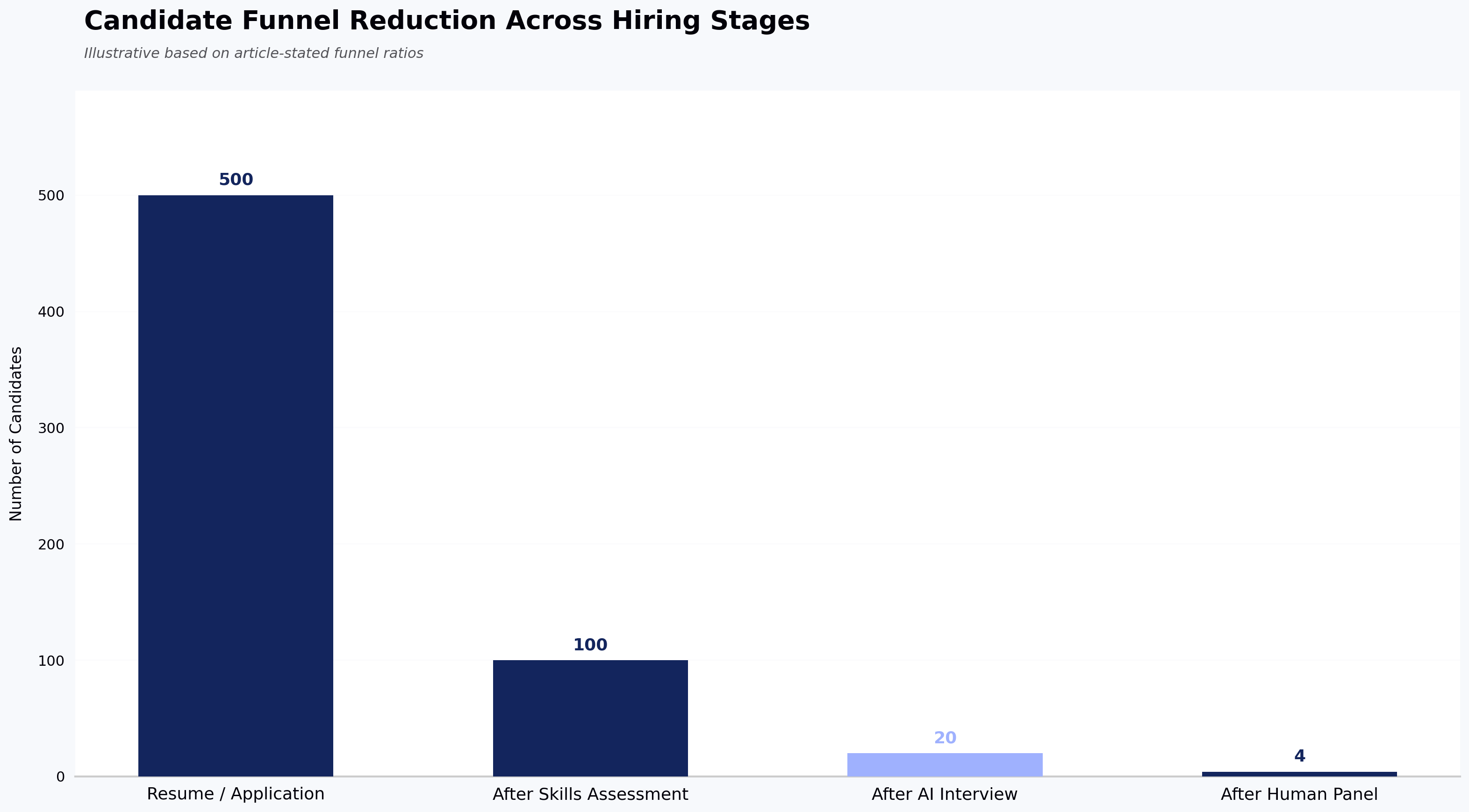
The operational split most companies land on: AI handles the first screen, humans handle everything past it. For a deeper role-by-role breakdown, see when AI interviews work and when they don't.
How do AI and human interviewers evaluate candidates?
AI evaluation is rubric-first. Every answer gets scored against pre-defined criteria, weighted, and rolled up into a report. Two candidates who give equivalent answers get equivalent scores.
Human evaluation is impression-first, rubric-second. Interviewers form a quick read in the first five minutes and then, if the process is well-designed, force themselves to check that read against a scorecard. If the process is not well-designed — which describes most hiring processes — the scorecard becomes a post-hoc justification for a gut call made in minute three.
The Schmidt and Hunter (1998) meta-analysis — still one of the most-cited pieces of hiring research despite its age — found that structured interviews predict job performance meaningfully better than unstructured ones (validity coefficients of roughly 0.51 vs. 0.38). AI interviewers are structured by construction. Human interviewers are structured only if the interviewer is disciplined. For teams looking to tighten this, see how to create a structured interview process.
AI interviewer vs. human interviewer: technical evaluation
For technical roles, the comparison gets more specific. AI interviewers can run live coding, ask system design questions, evaluate code against test cases, and probe on reasoning — all against a fixed rubric. What they cannot do well is judge the quality of a candidate's design instincts under ambiguity, or extend a productive whiteboard tangent for 20 minutes because it revealed something interesting.
For junior and mid-level technical hiring, AI interviewers cover most of what a first-round human screen would cover. For staff and principal engineering hires, they don't. The interview at that level is partly evaluation and partly negotiation — the candidate is deciding whether the interviewer is someone they want to work with. AI does not carry that signal in either direction.
The clean split: use AI for the screening interview, and use humans on a collaborative live-coding platform — FaceCode, CoderPad, or CodeSignal — for the panel and system design rounds, where a shared IDE and playback matter more than automated scoring.
AI interviewer vs. human interviewer: accuracy and consistency
Consistency is where AI wins outright. A single interviewer scoring 40 candidates over three weeks will drift — the rubric they applied in week one is not the rubric they apply in week three. An AI system does not drift.
Accuracy is more nuanced. On rubric-fit criteria — did the candidate answer the question correctly, did their code pass the tests, did they explain their reasoning — AI is at least as accurate as a human, often more. On criteria that require context — is this candidate underselling themselves because they are nervous, is the gap in their resume a red flag or a caregiving story — AI is worse, and the honest answer from most vendors is that AI is not trying to make that call.
A 2025 scenario-based experimental study in the Asian Journal of Social Psychology found that candidates in AI-led interviews reported lower self-efficacy than in human-led interviews. Field-level evidence in live hiring is still thin, but the direction is worth taking seriously as a design constraint: if the format itself dampens candidate performance, the score risks reflecting the format, not the candidate.
AI interviewer vs. human interviewer: candidate experience
Candidate reactions to AI interviewers are genuinely mixed, and vendor-supplied statistics on candidate preference should be read with skepticism — the platforms selling AI interviews are the ones publishing the surveys.
What is defensible from our experience with enterprise customers running AI screening at scale: candidates value speed and availability. A candidate who applies on a Sunday and gets a full interview slot the same evening rates the experience higher than one who waits eight days for a recruiter callback that gets rescheduled twice. That is not an AI-vs-human preference — it is an availability preference that AI happens to satisfy.
Candidates who dislike AI interviews cite two things: the feeling of talking to a wall, and the suspicion that the system is scoring them on things they cannot see (tone, pace, "confidence"). Both are legitimate concerns. Teams deploying AI interviews should be explicit with candidates about what is being evaluated and what is not.
AI interviewer vs. human interviewer: cost and scalability
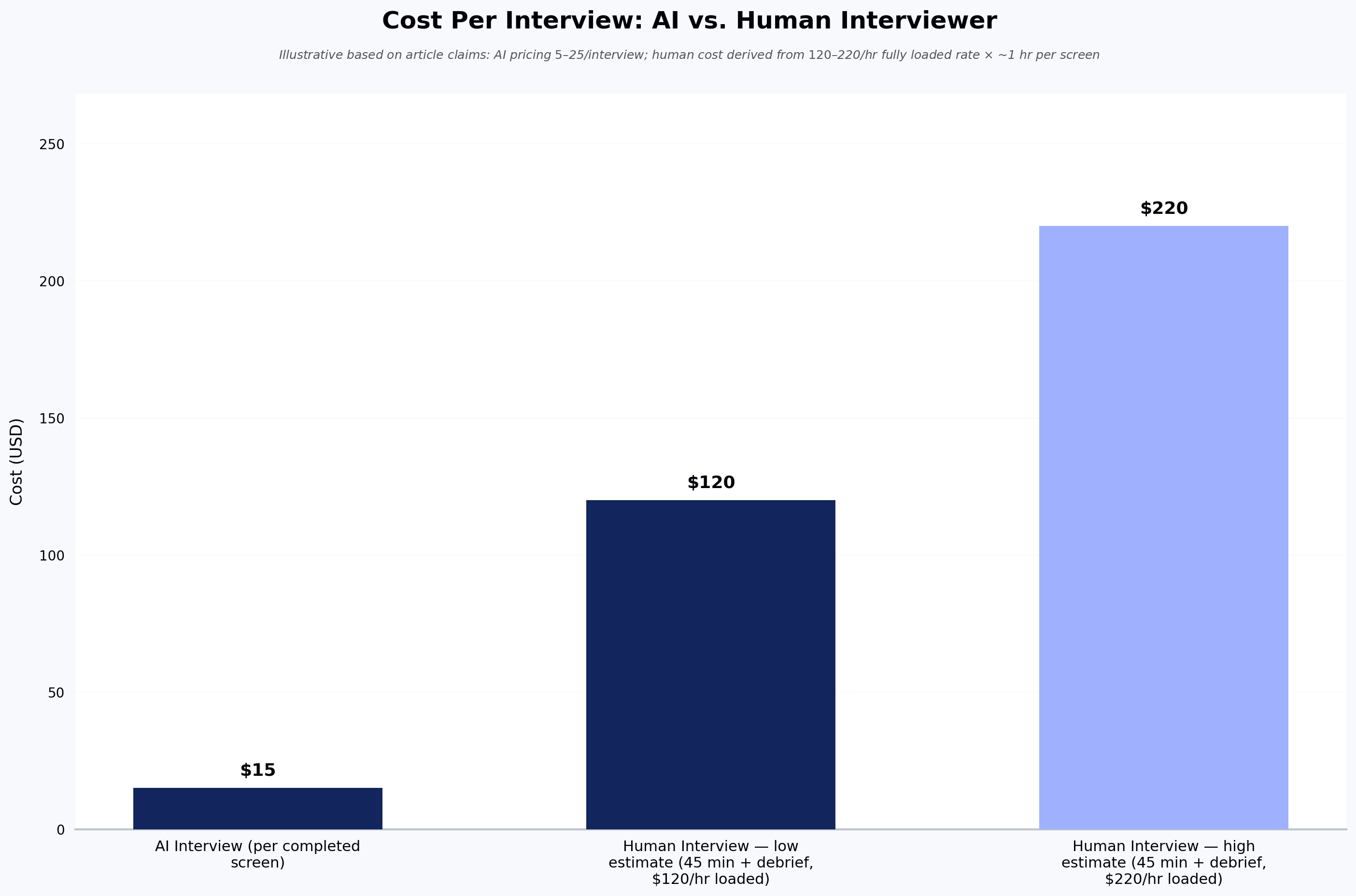
The cost comparison depends on what you count. A senior engineer's fully loaded hour — base compensation plus benefits, equity, and overhead — typically runs roughly $120–$220 at large or well-funded tech companies, based on public salary data (Glassdoor, Salary.com) with a standard 1.3–1.4× loading multiplier. In our experience with enterprise customers, the higher end of that range is closer to what FAANG-tier employers actually spend on interviewer time. A first-round technical screen takes 45–60 minutes plus 15 minutes of debrief. Multiply by every candidate who gets to first round, and the annual cost of human first-round screening at a company hiring 200 engineers a year runs into the mid-six figures — most of it engineer time, not recruiter time.
AI interview pricing varies by model: most commercial platforms (HireVue, Spark Hire, Willo) publish only subscription or seat-based pricing, while usage-based plans, where available, typically run $5–$25 per completed interview at non-enterprise tiers. Enterprise contracts are almost always custom-priced. That is roughly 5–10× cheaper per interview than the human alternative when you include senior engineer time, and more at the extremes of both ranges. The math flips only if you were previously screening candidates with junior recruiters and now want AI to replace what a senior engineer would have done anyway — a scope creep the AI vendors rarely correct.
Scalability is where the gap widens further. Modern AI interview platforms can run thousands of screening interviews in parallel over a single weekend — the kind of volume that is not achievable with human panels regardless of headcount.

How do AI and human interviewers handle interviewer bias?
Bias in AI interviewers is different from bias in humans — not necessarily less, but different. Human interviewers are biased by physical appearance, accent, shared background, time of day, and mood. AI interviewers are biased by training data, by the audio and video features the model was trained to weigh, and by the demographics of the population the model was validated on.
The honest framing is that AI produces more consistent evaluation across candidates — the same candidate answering the same way gets the same score — while human interviews produce more variable evaluation that averages out across many interviewers but hits individual candidates unpredictably. Neither is bias-free.
For BFSI and other regulated hiring contexts, the defensibility argument favors AI on record-keeping: every interview is recorded, every score has a rubric-linked justification, and the audit trail exists by default. For teams facing adverse-impact scrutiny, that trail is worth more than the marginal accuracy debate.
What are the benefits and limitations of AI interviewers?
Benefits:
- 24/7 availability, no scheduling friction
- Consistent rubric application across every candidate
- Complete audit trail for compliance and calibration
- Order-of-magnitude cost reduction on first-round screening
- Identity verification catches proxy candidates before they reach a senior interviewer
Limitations:
- Cannot read context outside the rubric (nervousness, unusual career paths, cultural nuance)
- Not appropriate for senior or leadership hires where negotiation and mutual evaluation matter
- Candidate self-efficacy runs lower than in human interviews, which can suppress candidate performance
- Vendor-supplied efficacy metrics that are cherry-picked and should be read as ranges, not point estimates
- Upfront investment in rubric design — a bad rubric produces bad scores at scale, and the scale is the problem
What are the benefits and limitations of human interviewers?
Benefits:
- Judgment on ambiguous cases (career transitions, non-standard backgrounds)
- Candidate rapport and mutual evaluation for senior hires
- Flexibility to pursue unexpected threads productively
- Better read on fit criteria that don't fit a rubric
Limitations:
- Inconsistent across interviewers and across time
- Expensive per candidate, especially when the interviewer is a senior engineer
- Scheduling delays that drive candidate drop-off, especially for in-demand technical candidates
- Bias is harder to audit and correct
- Interviewer burnout at high hiring volumes degrades signal further
When should companies use an AI interviewer?
Use an AI interviewer for the first structured screening round when hiring volume exceeds what your team can handle without introducing scheduling delays. Specific triggers:
- Requisition volume above 20 open technical roles simultaneously
- Time-zone spread that creates multi-day scheduling delays
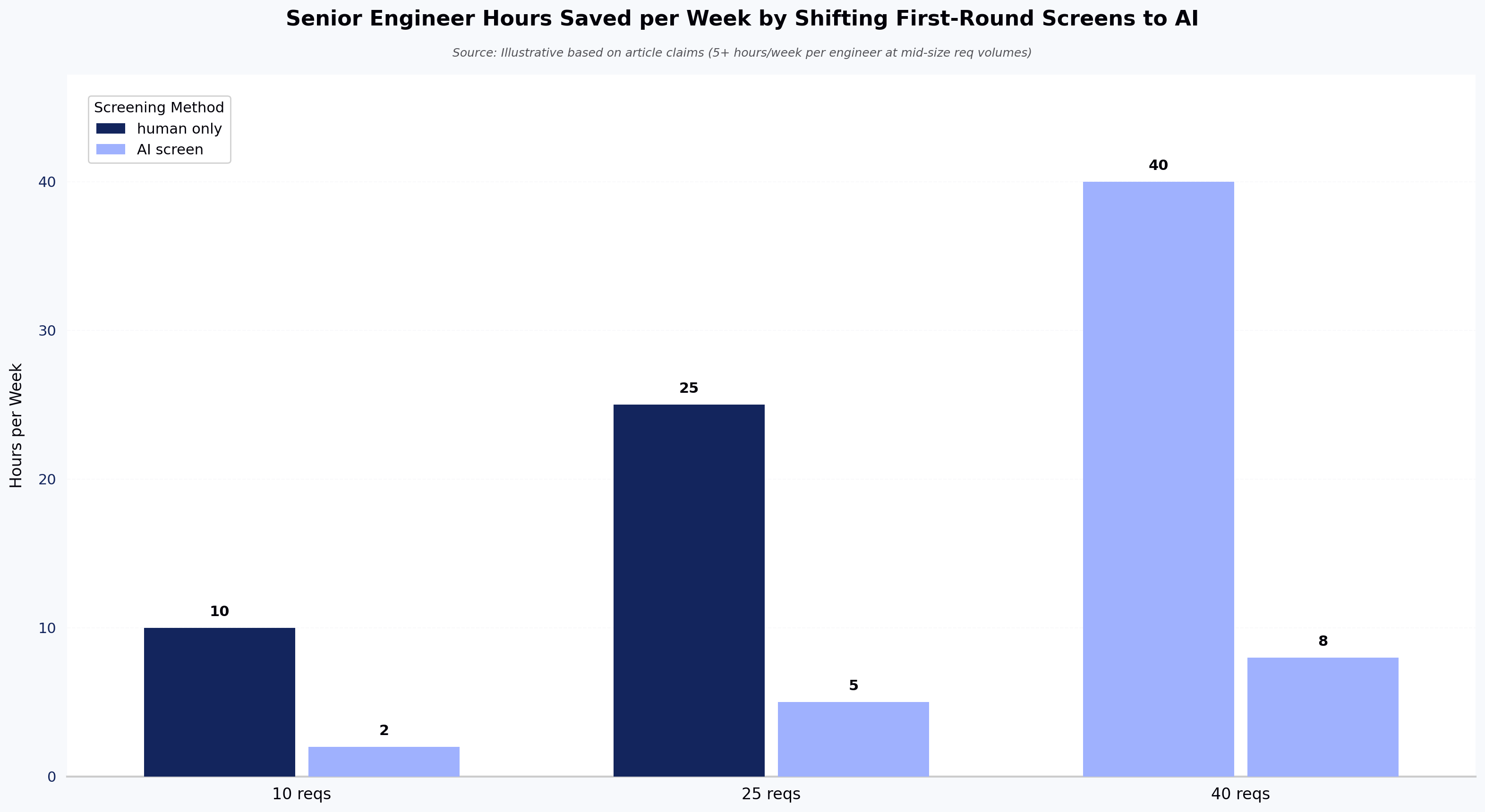
- Senior engineers spending more than five hours per week on screening
- Concerns about proxy candidates or AI-generated resumes reaching senior stages
- Campus or high-volume hiring where consistency matters more than nuance
The AI interviewer earns its place at the top of the funnel, where the job is to filter reliably, not to charm.
When is a human interviewer more appropriate?
Human interviewers are the right call for anything past the initial screen where judgment, negotiation, or mutual evaluation matters. Specifically:
- Staff, principal, and leadership hires where the interview is partly a sales conversation
- Roles with unusual career paths where a rubric filter would eliminate strong candidates
- Culture, values, and team-fit conversations
- Final-round system design and architecture discussions
- Any interview where the goal is as much about closing the candidate as evaluating them
Can AI and human interviewers work together?
Yes — and in teams running structured technical hiring at scale, they already do. The pattern that works: AI handles the first screen and the identity verification, humans handle the panel, the system design round, the hiring manager conversation, and the offer close. For a practical walk-through of this handoff, see how to use AI interview tools without losing human judgment.
This split does two things at once. It removes the highest-volume, lowest-judgment work from senior engineers, freeing them to spend interview time where their calibration actually matters. And it gives candidates a faster path through the funnel — a first-round result in 24 hours instead of 10 days.
For teams designing this loop, the structured interview design and rubric are the leverage points. A bad rubric applied consistently by AI produces bad hires at scale. A good rubric applied consistently produces the opposite. Invest in the rubric first, then pick the tools.
How to choose between an AI interviewer and a human interviewer
The choice is rarely all-or-nothing. To decide where to place each in your loop, ask four questions:
- What is the funnel volume at this stage? Above 50 candidates per role per month, structure and consistency dominate; AI earns the slot. Below 10, human judgment is cheap enough that AI is optional.
- How senior is the role? Junior and mid-level technical roles suit AI screening. Staff and above need a human in every round.
- How defensible does the process need to be? BFSI, regulated hiring, and any process facing DEI audit benefit from AI's built-in audit trail.
- What is the cost of a bad hire versus a missed hire? AI reduces missed hires (scheduling loss, drop-off) at some cost to nuanced judgment. If your top candidates are being lost to slow response times, AI is the higher-leverage fix.
If you are running technical hiring at scale, the answer is almost always "both, in the right places." The teams that treat this as a binary spend the next 18 months rediscovering that they need the other half.
Frequently asked questions about AI vs. human interviewers
Should we disclose to candidates that the first-round interviewer is AI? Yes, and explicitly. Tell candidates the format is an AI-led structured screen, what will be evaluated (answers against a rubric, code correctness, reasoning), and what will not (tone scoring, "confidence" inference, appearance). Candidates who understand the format perform closer to their real level, and disclosure removes the main source of post-interview complaints — the suspicion of being scored on invisible criteria.
Is an AI interview a red flag? Not by itself. A company using AI for first-round screening is usually optimizing for candidate response time and interviewer consistency — both of which benefit candidates. The red flag is when AI is used past the screening stage without human involvement in later rounds. If you never speak to a human before an offer, the company has skipped the parts of the process that should be evaluating mutual fit. The fair concern candidates raise on forums like r/recruitinghell is that an all-AI pipeline with no human contact can signal low employer investment in the hire — which is why the AI-first-screen, humans-past-that split matters as much for candidate trust as for accuracy.
Are companies actually using AI interviewers? Yes, and increasingly at enterprise scale. In our experience working with enterprise customers, AI interview adoption accelerated sharply through 2024 and 2025 as AI-generated resumes made resume screening unreliable and volume made human screening unaffordable. The pattern is concentrated in high-volume technical hiring, campus recruiting, and BFSI compliance-driven contexts.
Does AI reduce hiring bias? It changes bias more than it reduces it. AI produces more consistent evaluation across candidates but can encode bias from training data. The defensible claim is that rubric-applied AI evaluation doesn't vary by interviewer mood or fatigue — not that it is bias-free. For teams optimizing for defensibility and audit trail, that consistency is worth real money.
Can AI interviewers assess soft skills? Partially. Communication clarity, structured reasoning, and question comprehension are all measurable from an AI interview transcript. Empathy, humor, cultural fit, and stakeholder navigation are not. Any vendor claiming full soft-skills evaluation from a 30-minute AI interview is overselling.
How can I tell if an interviewer is AI? A few reliable signals: the interview is launched from an emailed link rather than a calendar invite with a human's name; the interface shows an avatar or voice-only prompt with a fixed question sequence; the interviewer does not reference specifics from your resume beyond what you typed into the application; follow-ups are triggered by keywords in your answer rather than genuine curiosity; and you cannot ask the interviewer questions back and get a substantive reply. Most reputable employers now disclose the format upfront — if you are unsure, ask the recruiter directly.
Key takeaways
- AI interviewers win on consistency, scale, cost, and audit trail; human interviewers win on judgment, ambiguity, and mutual evaluation.
- The right architecture is not either/or — AI at the top of the funnel, humans past the first screen.
- Rubric quality matters more than tool choice. A bad rubric applied by AI produces bad hires faster.
- Vendor efficacy statistics are cherry-picked; run your own before/after measurement before committing.
- For senior technical hires, human interviewers still carry signal AI does not.
See it in action
If you are evaluating where AI interviewing fits in your loop, schedule a demo of HackerEarth OnScreen to see how structured AI interviews work alongside your existing panel process — and where the handoff between AI and human interviewers should sit for your role mix.