AI Interviewer for Technical Screening: A Practical Guide
An AI interviewer for technical screening is software that conducts structured, role-calibrated technical interviews with candidates usually through voice or video and scores their responses against a fixed rubric. It sits between the resume review and the human panel, doing the work that senior engineers used to do at 4pm on a Friday: asking coding questions, probing on reasoning, and deciding who deserves a live conversation.
The category has moved fast in the last 18 months. What was a chatbot filling out a scorecard in 2023 is now, at its better end, a video-avatar interviewer that holds a two-way conversation, watches the candidate write code, and verifies identity before starting.
The rest of this piece explains how an AI interviewer for technical screening actually works, what it evaluates well, where it fails, and how to decide whether it belongs in your hiring stack.
What is an AI interviewer for technical screening?
An AI interviewer for technical screening is an automated system that runs a structured technical interview coding, system design, or role-specific questions without a human interviewer present. It uses a large language model plus a rubric to ask questions, follow up on candidate answers, evaluate responses, and produce a scored report.
The category splits into two shapes.
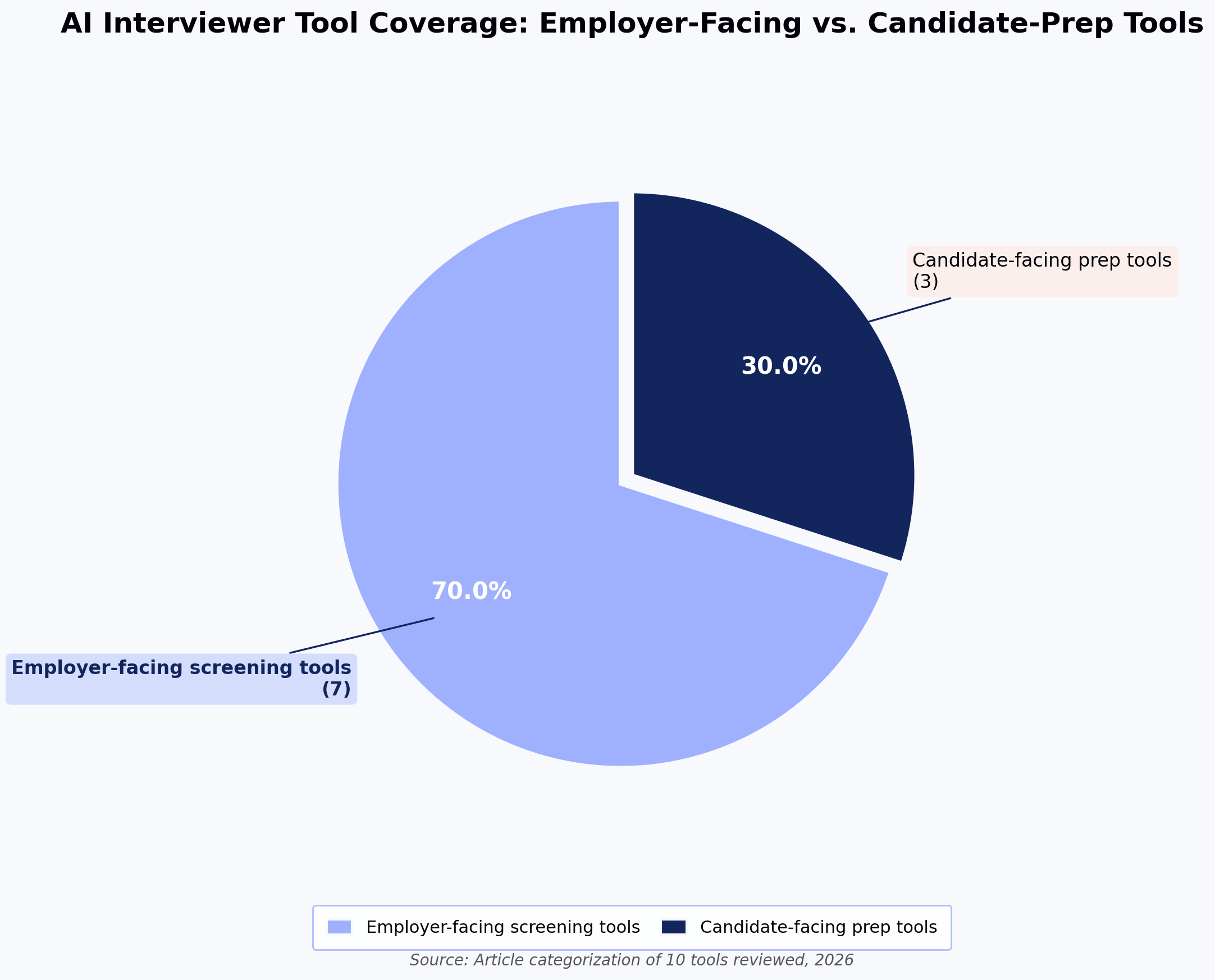
- The first is candidate-facing practice tools (MockAI, Interviews by AI, interviewing.io's practice mode, HackerRank's mock interview product) that help job seekers prepare.
- The second - the one this article is about is employer-facing screening tools that replace the recruiter phone screen or the first-round technical interview. HackerEarth's OnScreen and Interviewer.AI sit in this second category, though they differ substantially in what they actually do.
The point of an AI interviewer for technical screening is not to replace human judgment on culture, seniority, or hiring conviction. It is to remove the scheduling friction, calibration drift, and senior-engineer time cost from the first 30–60 minutes of the interview process.
How does an AI interviewer conduct a technical screening?
The flow is roughly consistent across the serious platforms:
- The candidate receives a link and completes identity verification usually ID capture plus a live selfie match.
- The system loads a role-specific interview plan built from the rubric the hiring team defined.
- An AI avatar or voice agent opens the conversation, asks a warm-up question, and moves into the technical portion.
- For coding questions, the candidate writes code in an embedded editor while the AI observes, asks clarifying questions, and probes on reasoning.
- The system evaluates responses against the rubric - correctness, complexity, edge-case handling, communication and produces a scored report with a recommendation.
- A proctoring layer flags anomalies: tab switches, second-person voice detection, large paste events.
The interview typically runs 30–60 minutes. Better platforms adapt follow-ups based on what the candidate says; weaker ones read from a script and evaluate against keyword matches.
Why are companies using AI interviewers for technical screening?
Three structural problems in technical hiring made the category inevitable.
Volume outstripped capacity. A mid-size product company running 40 engineering reqs at once cannot get senior engineers to do first-round screens without slowing shipping. IT services firms running campus programs at 50,000+ candidates a year cannot do it at all with humans.
AI-generated CVs broke resume signal. By 2024, recruiters were anecdotally reporting cover letters and resumes that were obviously generated, and take-home submissions that didn't match the candidate's actual ability once they reached a live conversation. The first-round conversation became load-bearing in a way it hadn't been before and there were too many of them to run. This is the problem AI-generated CVs create for technical hiring, and the reason the live conversation matters more now than it used to.
Scheduling was quietly losing candidates. A strong developer who applies on Thursday evening and gets a Monday morning email is often gone by Tuesday. Async, always-on screening addresses this directly.
None of these problems is new. What changed is that the tooling caught up enough to make the trade-off worth it for a growing set of use cases.
What skills can an AI interviewer evaluate?
An AI interviewer for technical screening evaluates skills that show up in structured, observable behavior: coding correctness, algorithmic reasoning, language fluency, communication of technical concepts, and with the right question design approach to ambiguity.
Concretely, a well-configured system can assess:
- Coding proficiency in 40+ languages, judged on correctness, complexity, and edge-case handling
- Problem-solving approach - how a candidate decomposes a problem and communicates their thinking
- Fundamentals - data structures, algorithms, database queries, API design
- Communication - whether the candidate can explain what they're doing and why
- Role-specific knowledge - framework-specific questions, systems concepts, domain fluency
What it evaluates poorly: seniority judgment on ambiguous design questions, cultural signals that require reading the room, and the "would I want to work with this person" question. These belong in a human round.
What types of technical interviews can an AI interviewer conduct?
The category handles three interview formats well and one badly.
Handled well: structured coding interviews (medium-difficulty algorithmic questions with a clear rubric), language- or framework-specific technical Q&A, and role-based screens for adjacent technical roles like data analysts, SDETs, and backend engineers up to mid-level.
Handled with caveats: system design interviews. The better platforms give candidates a drawing canvas and let the AI probe on scalability, trade-offs, and reasoning. But senior system design the kind you'd run for a staff-level hire still benefits from a human who can push back with context the AI doesn't have. For a fuller picture of where AI interviews work and where they don't by role and seniority, it's worth mapping the tool to the level you're hiring for before rolling it out.
Handled badly: open-ended senior conversations where the goal is calibration on judgment, past decisions, and technical taste. If you're hiring a principal engineer, use the AI interviewer to filter noise from the top of the funnel, not to make the hire/no-hire call.
How does AI interviewing fit into the technical hiring process?
The most common configuration is a three-stage funnel: skills assessment → AI interview → human panel.
The assessment filters for baseline coding ability at high volume 500 applicants down to 100. The AI interview does the structured conversational screen 100 down to 20. The human panel does the deep technical evaluation and hire decision 20 down to offer.
Some teams skip the assessment stage and go straight to AI interview when the top-of-funnel volume is manageable. Others use the AI interview as the second-round after a recruiter phone screen, replacing what used to be the "junior engineer does a 45-minute technical screen" step. The right configuration depends on volume, seniority, and how much senior engineer time you're currently burning on screens.
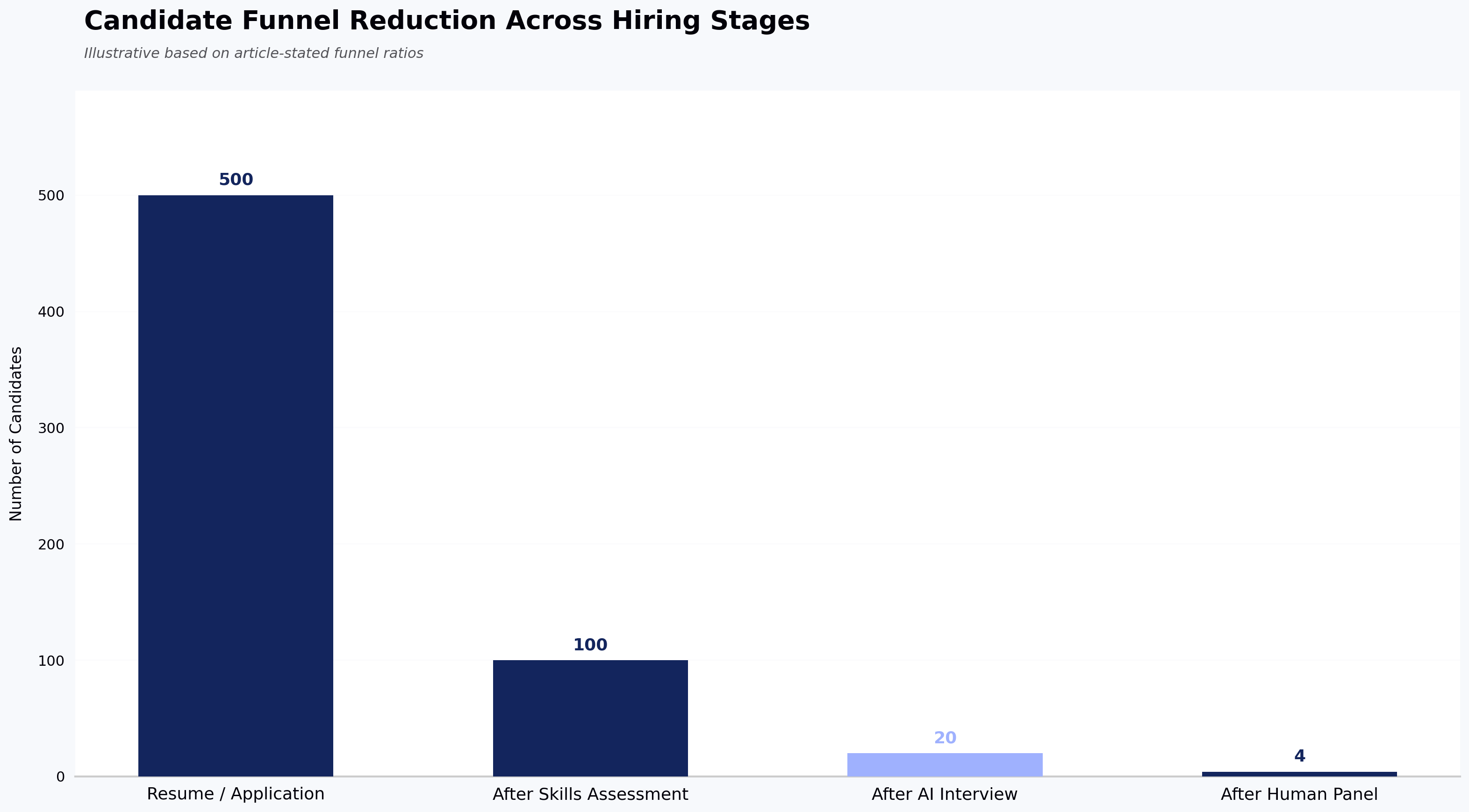
Source: Illustrative based on article-stated funnel ratios
How does an AI interviewer assess coding and problem-solving skills?
The evaluation combines three signals: correctness, complexity, and reasoning quality.
- Correctness is judged by running the candidate's code against test cases, including edge cases the candidate may not have anticipated. This is the most mechanical piece and the most reliable.
- Complexity is evaluated against the rubric does the solution run in the expected time and space, or did the candidate ship an O(n²) approach when O(n log n) was the target? Good systems flag this and probe the candidate to see if they recognize the trade-off.
- Reasoning quality is the harder one. The AI asks follow-up questions: "Why did you choose that data structure?" "What happens if the input is 10 million records?" "How would you test this?" The candidate's answers not just their code feed the final score. This is where the category has improved most in the last 18 months, and where the weaker tools still fall down.
What are the benefits of using an AI interviewer for technical screening?
The benefits fall into four buckets: time, consistency, coverage, and signal.
- Time. For teams where senior engineers are burning 5+ hours a week on first-round screens, that time is reclaimed. Recruiters stop chasing calendar slots across time zones. Candidates get faster responses.
- Consistency. Every candidate gets the same questions asked the same way with the same rubric applied. Interviewer mood, fatigue, and drift stop being variables. This matters for defensibility as much as fairness rubric-applied evaluation holds up under audit in a way "the panel had a good feeling" doesn't.
- Coverage. The interview runs when the candidate is available. A candidate who applies Sunday at 11pm gets a full technical screen before Monday morning. This matters most in high-volume and cross-timezone hiring.
- Signal on real skill. AI interviewers with identity verification and live-coding observation are harder to game than take-home assignments or written cover letters. That closes a gap that got much wider after 2023.
The trade-off is real: you lose the recruiter's gut read on the candidate, the informal conversation that sometimes surfaces a great hire the rubric would have missed, and the employer-brand touch of a warm human first contact.
Teams that value those things heavily should keep the human phone screen and use the AI interviewer later in the funnel.
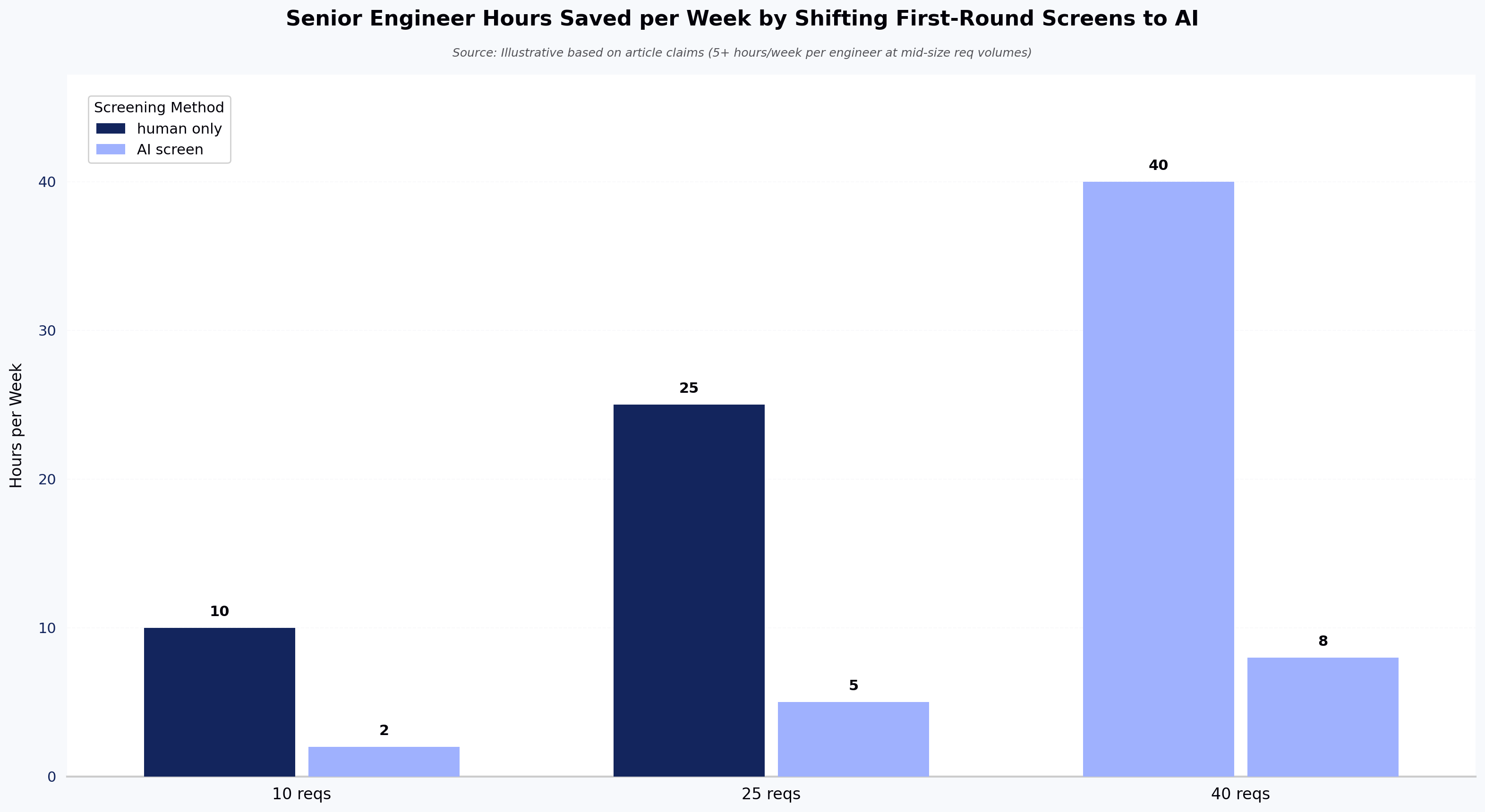
Source: Illustrative based on article claims (5+ hours/week per engineer at mid-size req volumes)
AI interviewer vs. traditional technical interview: what's the difference?
The clean distinction: a traditional technical interview is optimized for judgment, an AI interviewer is optimized for filtering.
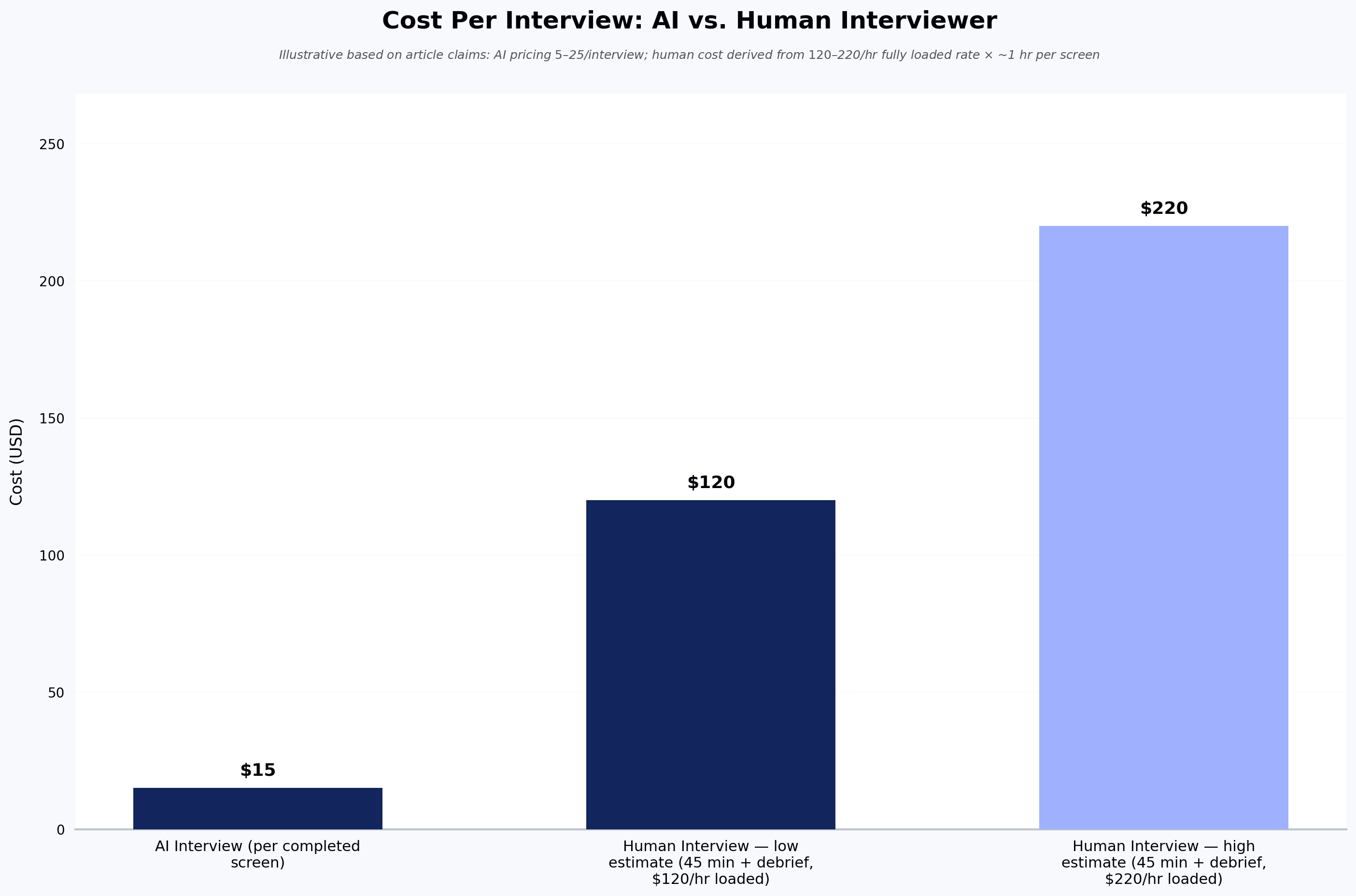
A traditional first-round technical interview with a human costs 45–60 minutes of a senior engineer's time, produces a subjective assessment shaped by that specific interviewer's calibration, and happens on a schedule that suits the interviewer. Its strength is that the interviewer can follow an unexpected thread, adjust based on the candidate's background, and make a hire/no-hire call informed by things the rubric doesn't cover.
An AI interviewer for technical screening costs no engineer time, produces a scored assessment against a fixed rubric, and runs when the candidate is ready. Its strength is consistency at scale. Its weakness is exactly what makes the human version strong it doesn't follow unexpected threads well, and it can't make judgment calls that require context outside the rubric.
The right answer is almost never "one or the other." It's "AI interviewer first, human panel for the candidates who pass."
What features should you look for in an AI interviewer?
Six features separate serious AI interviewers for technical screening from the noise: identity verification, genuine two-way conversation, deterministic rubric application, language and role coverage, proctoring that doesn't punish honest candidates, and ATS integration.
- Identity verification. Without KYC-grade identity checks, you're measuring whoever showed up, not the candidate. This became table stakes as proxy candidates got more common.
- Genuine two-way conversation. A chatbot filling out a scorecard is not an interview. Look for platforms where the AI asks unscripted follow-ups based on what the candidate actually said. The difference is obvious in a demo ask to see a real recording, not a scripted walkthrough.
- Deterministic rubric application. Every candidate should be evaluated against the same rubric with the same scoring model. Ask how the vendor prevents rubric drift and how they handle rubric updates mid-hiring-cycle.
- Language and role coverage. If you hire across languages and role types, the platform needs a question library that covers them. Question library depth is where many of the newer entrants are thin.
- Proctoring that doesn't punish honest candidates. Anti-cheat theater flagging every tab switch, every glance away creates false positives that damage candidate experience without catching real cheating. Look for platforms that flag anomalies for human review rather than auto-rejecting.
- ATS integration. The reports need to flow into your ATS. If a recruiter has to copy scores manually into Greenhouse or Workday, the time savings evaporate.
How can AI interviewers support high-volume technical hiring?
At scale, the AI interviewer stops being a convenience and becomes structural. IT services firms running campus programs and product companies with global req pipelines face the same math: they need to screen more candidates than any interviewer team can absorb.
As a benchmark on scale: enterprise deployments have run thousands of rubric-applied screens in a single weekend - a throughput no human panel can match. The relevant comparison isn't "AI interview vs. human interview" it's "AI interview vs. no screen at all, applicants filtered by resume keyword match." The second is what most high-volume programs actually did before, and it produced worse hires than a rubric-applied AI screen.
The scale angle also matters for campus and pyramid-heavy hiring in IT services, where a large share of intake comes through campus programs and consistency across thousands of evaluations is the whole problem.
How do AI interviewers help create a consistent screening process?
Consistency comes from two properties: fixed rubric and no interviewer variance.
Every candidate is asked from the same question pool, scored against the same criteria, and evaluated by the same model. A candidate interviewed at 3am gets the same experience as one interviewed at 3pm. A candidate interviewed by "the AI" gets the same evaluation as another candidate interviewed by "the AI" not the wildly different assessments you get when Panel A includes the strict staff engineer and Panel B includes the founder who likes everyone.
This matters for three reasons: it makes calibration easier (the rubric is the only thing to argue about), it makes defensibility stronger under audit or litigation, and it produces cleaner data for quality-of-hire analysis six months later. Rubric-applied evaluation isn't zero bias - AI systems have their own bias profiles but it is more consistent across candidates than human-led screens.
What are the limitations of AI interviewers in technical screening?
Four limits are worth naming honestly.
- Judgment on ambiguity. When a senior candidate takes a question in an unexpected direction and reveals something interesting about how they think, a good human interviewer follows. Current AI interviewers mostly don't. If your bar is "can this person operate at staff level in an ambiguous domain," the AI screen alone won't tell you.
- Bias transferred from training data. AI models trained on existing hiring data can encode the biases in that data. This is different from "zero bias" it's a different bias profile, one that's more consistent across candidates but not neutral. Serious platforms audit for adverse impact; ask to see the audit.
- Gaming by well-prepared candidates. Candidates who prep specifically for AI interviews with rehearsed answers, second-monitor setups, or coaching tools can beat weaker platforms. Identity verification and live-coding observation close most of this gap. None of it closes all of it.
- Candidate experience risk. Some candidates hate AI interviews and read them as an insult. This is more true for senior candidates, less true for entry-level. If your employer brand is built on high-touch candidate experience, the AI interview belongs later in the process, not at the top.
How to choose the right AI interviewer for technical screening
Three questions decide the choice.
- First: what volume and seniority are you screening? High-volume junior-to-mid screening is where AI interviewers deliver the clearest ROI. Senior and staff hiring benefits more from AI-assisted live technical interviews with a human interviewer in the room.
- Second: what's your risk profile on defensibility? Regulated industries - BFSI especially need rubric-based evaluation with audit trails and adverse-impact analysis. Ask vendors specifically about their fairness auditing methodology, not just their marketing copy about it.
- Third: what does your existing stack look like? The AI interviewer needs to fit alongside your ATS, your assessment platform, and your video interview tools without creating another manual reconciliation step for recruiters. Integration friction kills more rollouts than any product limitation.
Run a paid pilot against a real requisition, not a demo. Measure quality-of-hire six months later, not just recruiter satisfaction at week one.
Frequently asked questions about AI interviewers for technical screening
Is an AI interview a red flag for candidates?
For some senior candidates, yes - it signals that the company doesn't value the early conversation enough to have a human do it. For most junior and mid-level candidates, it's neutral or positive, especially when the alternative is waiting two weeks for a human slot. The red flag is not the AI interview itself; it's an AI interview with no human contact anywhere in the process.
Which AI interviewer is best for technical screening?
It depends on which side of the interview you're on. For candidates preparing for interviews, tools like MockAI, interviewing.io's practice mode, and HackerRank's mock interview product are the common choices. For employers screening candidates -the focus of this article - HackerEarth's OnScreen combines in-depth interviewing, integrated proctoring, and KYC verification in a single flow aimed at enterprise technical hiring. Interviewer.AI focuses on asynchronous video interviews with a broader non-technical role mix, which suits teams screening across business and technical functions. Match the tool to your volume, seniority mix, and integration needs not to a leaderboard.
How do candidates pass an AI interview?
Treat it like a real technical interview, because it is one. Think aloud, ask clarifying questions before writing code, handle edge cases explicitly, and explain your reasoning. The AI is scoring communication and problem-solving approach, not just correctness candidates who code silently score worse than candidates who narrate.
What happens when the AI screen passes a candidate the hiring manager later rejects?
This is the calibration case worth watching. If it happens once, it's noise. If it happens repeatedly with the same rubric, either the rubric doesn't match what the hiring manager actually values, or the AI is scoring surface signals the human panel discounts. The fix is to review the rubric with the hiring manager against the rejected candidates' transcripts not to lower trust in the AI screen or the panel in isolation. Vendors who can't show you the transcript and score breakdown make this loop impossible to close.
Can candidates cheat on AI technical interviews?
Weaker platforms without identity verification and live-coding observation are gameable. Serious platforms with KYC-grade ID checks, proctoring, and live code editors that watch for large paste events are meaningfully harder to cheat than take-home assignments were. The gap is not zero, but it's smaller than the pre-AI baseline.
Do AI interviewers replace human interviewers?
No, and vendors who claim they do are overselling. The right model is AI for structured screening, human for judgment-heavy rounds and the hire decision. For engineers, this means fewer hours on early screens. For recruiters, pipelines move faster. For candidates, the experience is consistent and skills-first, regardless of when they apply.
See it in action
The decision framework above match tool to volume and seniority, weigh defensibility, check integration fit only resolves against a real requisition. If you're evaluating AI interviewers for an actual hiring program rather than researching the category, the fastest way to judge fit is to run one against a live role.
Schedule a demo of HackerEarth OnScreen to see how structured AI interviews, identity verification, and rubric-based evaluation work together on a role you're actually hiring for.